Get your setup working faster. Join our Discord for optimisation tips from elite testers.Join our Discord
Integrate GitHub Actions with BrowserStack
A step-by-step guide to help you integrate GitHub Actions with the BrowserStack device cloud for running all your Selenium tests on BrowserStack Automate.
You need to have username and access-key from BrowserStack to be able to run tests on the BrowserStack infrastructure. This section shows how to set them as Secrets in your GitHub repository. You can sign-up for free trial if you do not have an existing account.
If you want to test your open source project on BrowserStack, then sign-up here for lifetime free access to all our products.
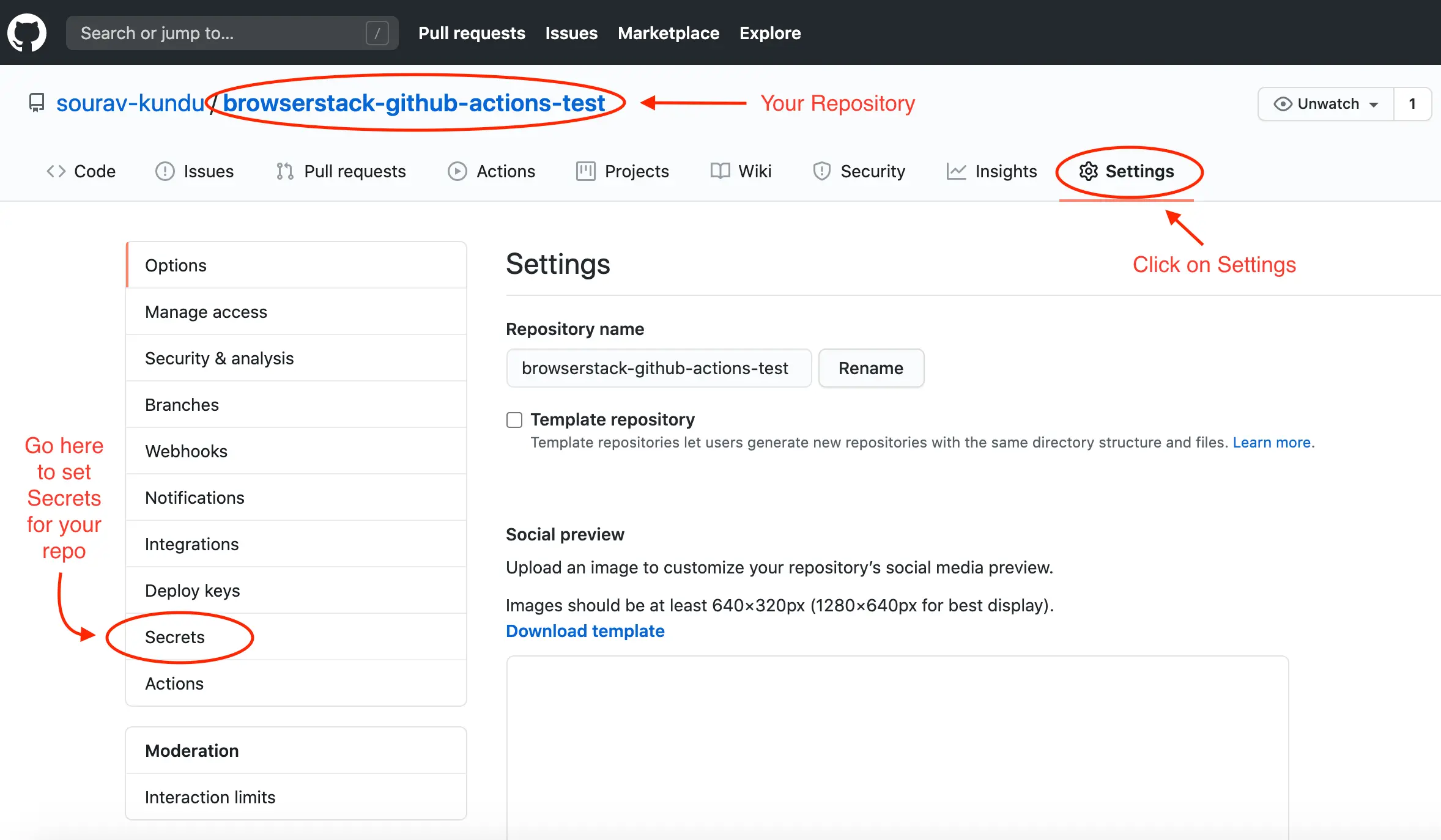
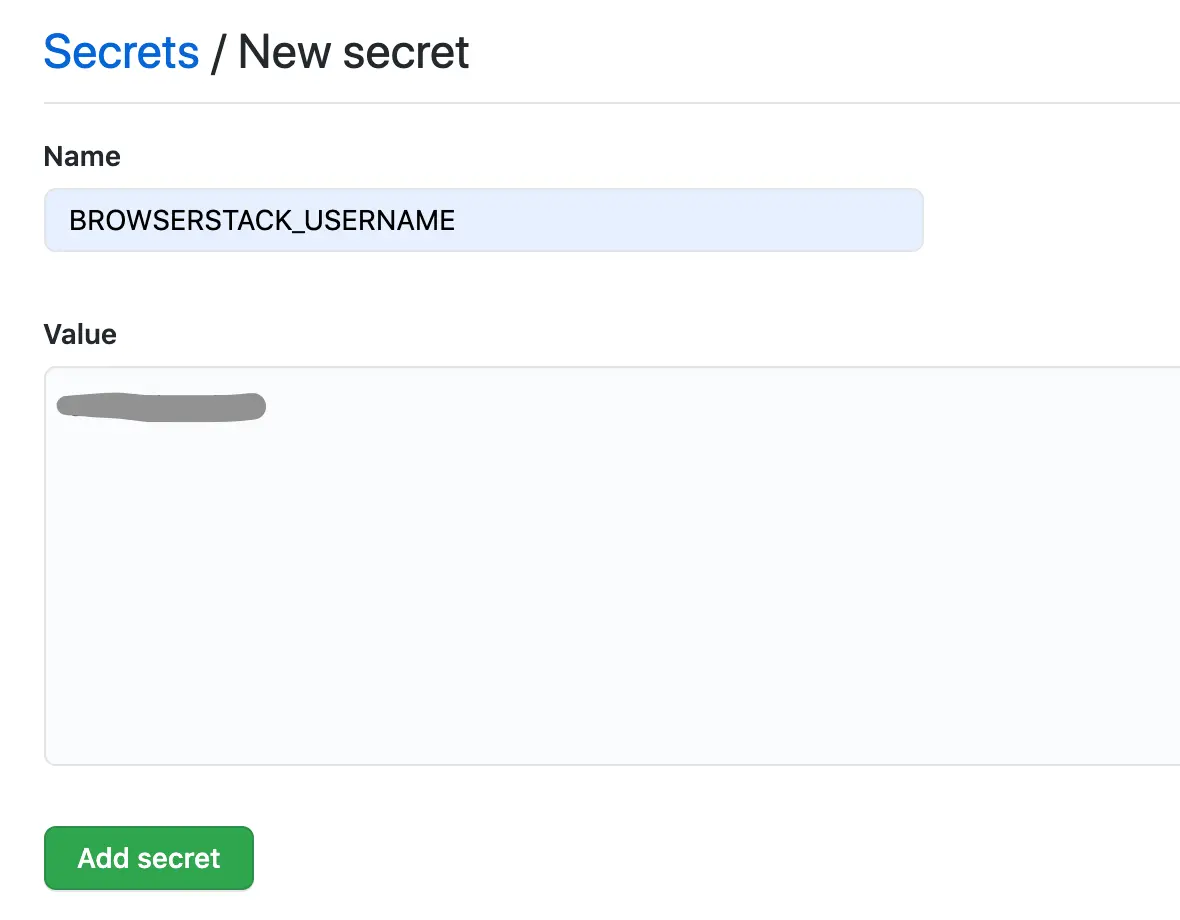
As the picture above suggests, go to Settings in your repository and there you will find the Secrets option in the left-hand pane. Go to Secrets and add new secrets as shown below:
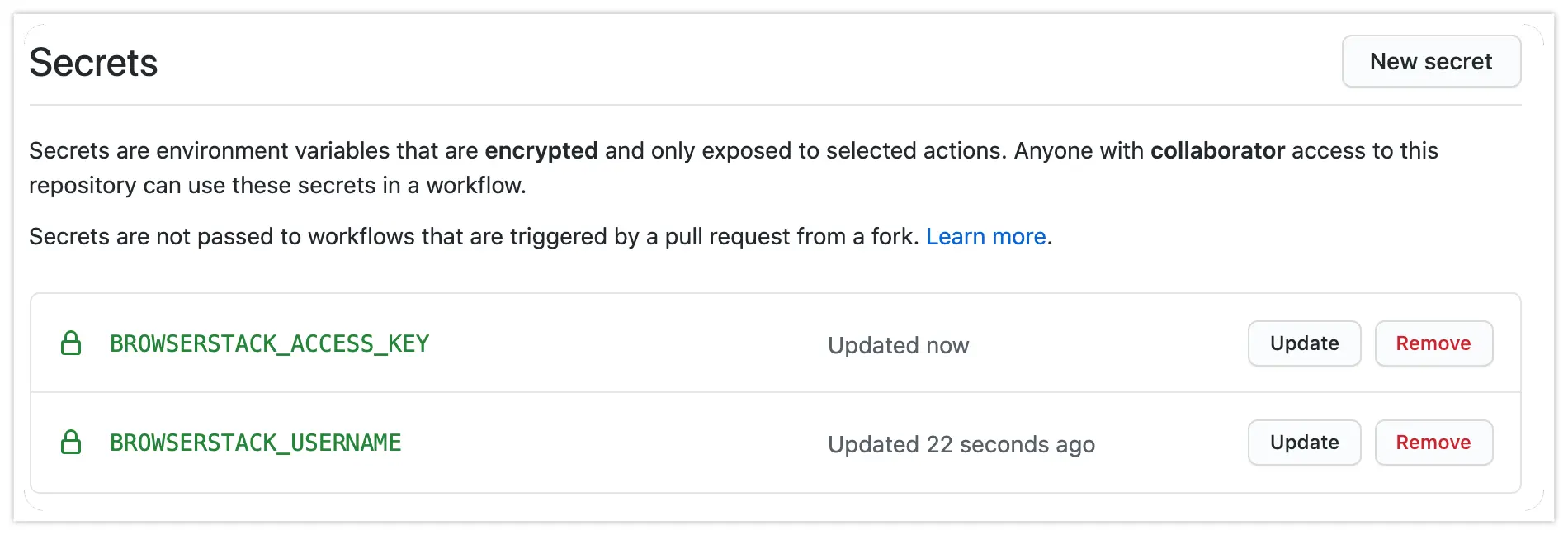
Add YOUR_USERNAME as the BROWSERSTACK_USERNAME secret and similarly, add YOUR_ACCESS_KEY as the BROWSERSTACK_ACCESS_KEY secret. After these two steps, the secrets page should contain entries like this:
Set up a GitHub workflow to run BrowserStack tests
You must do the following to run BrowserStack tests from GitHub Actions (see the sample GitHub workflow):
Create the workflow file(s) <filename>.yml in the .github/workflows directory in your repository. (Read more about creating GitHub Workflow files)
The starting of the workflow specifies on what events the workflow must run. We recommend you to run on both push and pull_request so that you have a 1:1 build mapping against every commit
You can run on any GitHub Actions runner e.g. ubuntu-latest (You can also host your own runners)
In the initial workflow steps, you must build your web application and start the web server on the runner
Invoke setup-local BrowserStack Action to set up a tunnel connection between the GitHub Actions runner environment and the BrowserStack device cloud so that the application server on the runner environment can be accessed by the browsers in BrowserStack’s device cloud
Run the test scripts from the workflow. (You can visit the Sample Test section to see how you can use the environment variables in your test script to set BrowserStack capabilities)
You can see the sample GitHub workflow to run a BrowserStack test. The next section explains the purpose and usage of the BrowserStack GitHub Actions in your workflow.
Use BrowserStack GitHub Actions in your workflow
You can find the BrowserStack GitHub Actions in the GitHub Marketplace. The following two Actions are used to set up the required environment variables in the runner environment and set up BrowserStack Local tunnel connection which will be used to route all browser traffic from BrowserStack’s device cloud to the runner environment which hosts your web application.
You can find the Action’s GitHub repository. This Action should be invoked from the runner environment before any other BrowserStack Action is invoked. This Action sets up the following environment variables in the runner environment which will later be used by other BrowserStack Actions and also in your test scripts to set BrowserStack specific capabilities:
BROWSERSTACK_BUILD_NAME: By default, this variable will be populated with a name for your build consisting of workflow run specific data. For e.g.
On pull_request → [<Branch-Name>] PR <PR#>: <PR-title> [Workflow: Workflow#] will be set
BROWSERSTACK_PROJECT_NAME: By default, the repository name will be set
BROWSERSTACK_USERNAME: Input of username will be set, to be used in test scripts.
BROWSERSTACK_ACCESS_KEY: Input of access-key will be set, to be used in test scripts.
Inputs
username: (Mandatory) Your BrowserStack username to be passed ideally as a GitHub Secret
access-key: (Mandatory) Your BrowserStack access-key to be ideally passed as a GitHub Secret
build-name: (Optional) Sets the environment variable BROWSERSTACK_BUILD_NAME
Default is BUILD_INFO which will be replaced with meaningful workflow related information
You can pass any string. E.g. build-name: 'my-string'
You can also use a string along with the keyword BUILD_INFO in the input
E.g. build-name: 'string1 - BUILD_INFO - string2'
project-name: (Optional) Sets the environment variable BROWSERSTACK_PROJECT_NAME
Default is REPO_NAME which will be replaced with the repository name
You can pass any string that you want to set as the BROWSERSTACK_PROJECT_NAME
E.g. project-name: 'My Project Name Goes Here'
The browserstack/github-actions/setup-env@master Action should be invoked prior to invoking this Action as a part of the same workflow job.
Inputs
local-testing: (Mandatory) The value can be either start or stop
start input will download the BrowserStackLocal binary and start the binary.
stop input will stop any running binary and if any log-level was set by local-logging-level, then the logs will be uploaded as artifacts. If you do not stop the binary after the completion of your tests, the logs will not be uploaded as artifacts.
local-logging-level: (Optional) The valid inputs are:
setup-logs: Logs to debug issues related to setting up connections will be saved.
network-logs: Logs related to the network information will be saved.
all-logs: All communication to local servers for each request and response will be saved.
Default: Input will be assumed as false when no input is provided and logs will not be saved.
local-identifier: (Optional) The valid inputs are:
random (Recommended option): A random string will be used as the identifier to start and distinguish the local binary instance. It will be saved in the environment variable BROWSERSTACK_LOCAL_IDENTIFIER and must be used in your test script as the capability ‘browserstack.localIdentifier’. (See sample code snippet)
<string>: Any string can be an input which will be saved in the same environment variable as above and must be used in your test scripts.
Default: No tunnel identifier will be used.
local-args: (Optional) Any additional argument to local binary can be passed using this input as a single string. See the complete list of supported local-binary arguments.
Example → local-args: '--force-local --proxy-host <HOST> --proxy-port <PORT> --proxy-user <USER> --proxy-pass <PASSWORD>'
The following arguments are already being included in the invocation of the local binary and hence, if you include any of them again in the local-args string, they will be ignored:
--key
--local-identifier
--daemon
--only-automate
--verbose
--log-file
local-identifier argument is strongly recommended to be set to ‘random’ so that the tunnel connection is distinguished by the identifier.
local-args is an optional argument and under normal circumstances, if the application is not hosted behind any proxy, this input would not be required. See the supported BrowserStackLocal binary parameters
Warning:
For local-logging-level input, the logs will only be saved and uploaded as artifacts only if this Action is invoked again with local-testing: stop as the input (after your test scripts have completed running)
Usage
Use the below code snippet in your workflow to start the BrowserStackLocal binary and establish the tunnel connection:
Use the code snippet below at the end of your workflow after the tests have completed. This will stop the BrowserStackLocal binary and upload the local binary logs (if any):
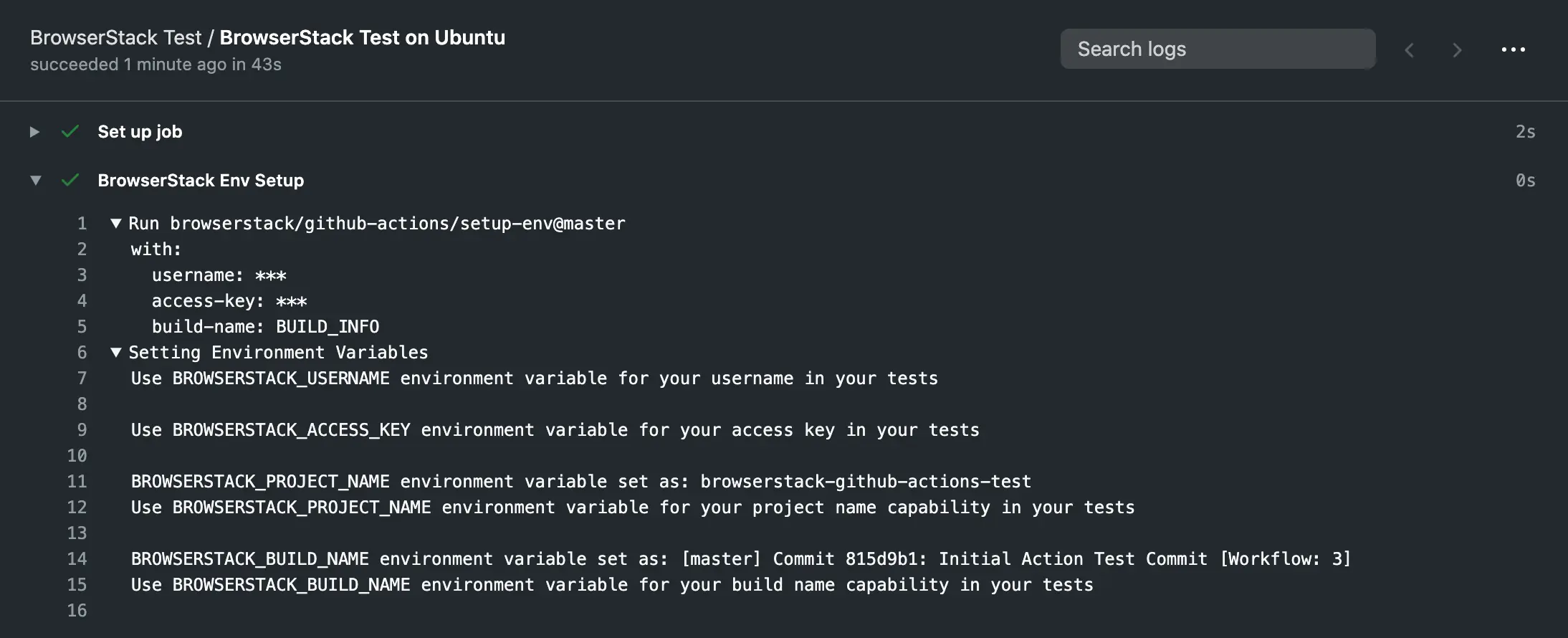
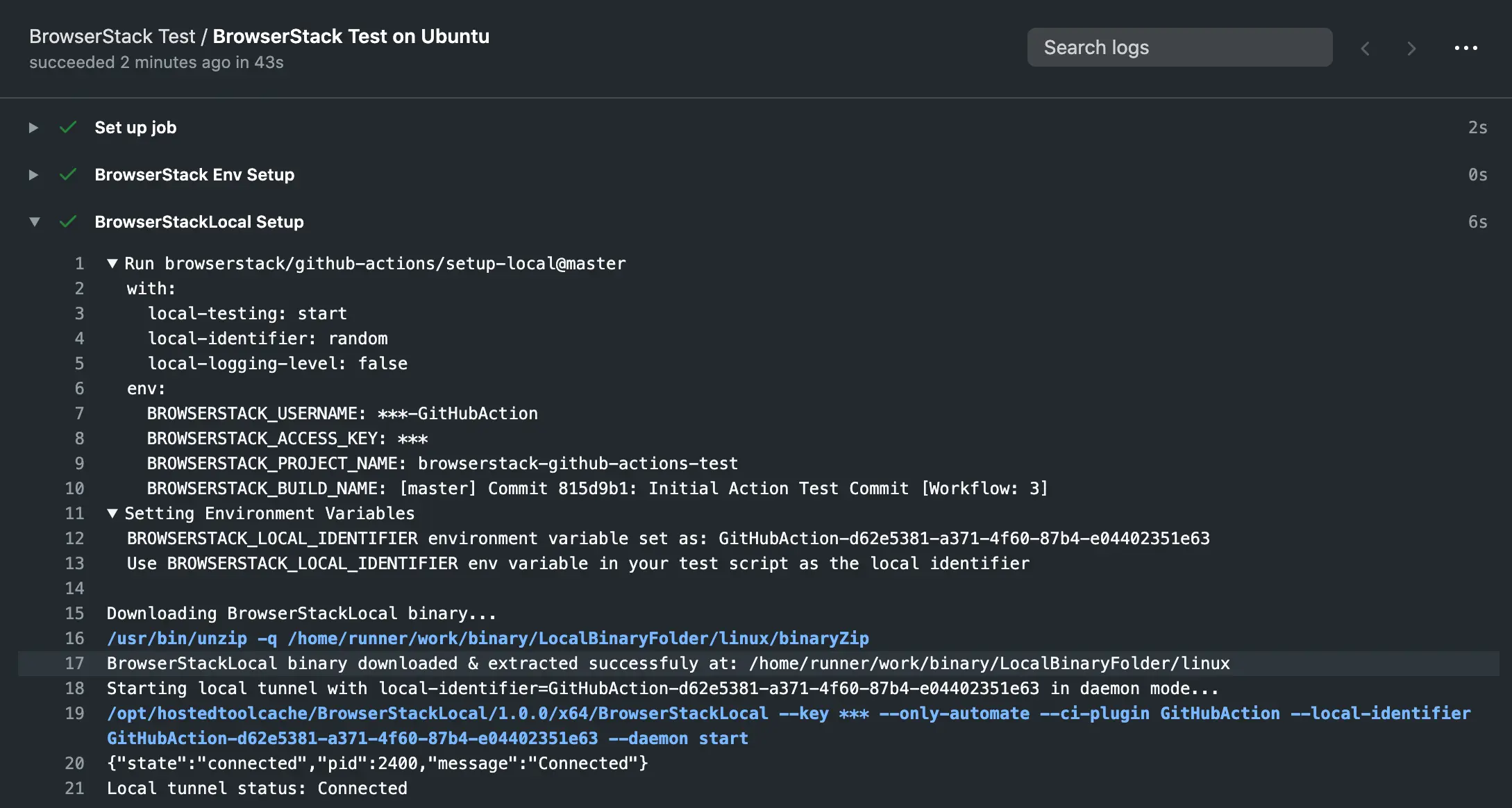
The console logs on GitHub Workflow console, on running this Action is like shown below:
Sample test script
The following sample test script (in the language of your choice) assumes that there is a HTTP web-server running on the runner environment’s port 8099. This script is just for showing the use of environment variables in capabilities. See the complete list of capabilities
To be able to run these test scripts in the GitHub Actions runner environment, you have to add a step(s) in the workflow to install the required Selenium bindings for the language of your choice.
// Sample test in Java to run Automate session.importorg.openqa.selenium.By;importorg.openqa.selenium.Platform;importorg.openqa.selenium.WebDriver;importorg.openqa.selenium.WebElement;importorg.openqa.selenium.MutableCapabilities;importorg.openqa.selenium.remote.RemoteWebDriver;importjava.util.HashMap;importjava.net.URL;publicclassJavaSample{publicstaticfinalStringAUTOMATE_USERNAME=System.getenv("BROWSERSTACK_USERNAME");publicstaticfinalStringAUTOMATE_ACCESS_KEY=System.getenv("BROWSERSTACK_ACCESS_KEY");publicstaticfinalStringLOCAL_IDENTIFIER=System.getenv("BROWSERSTACK_LOCAL_IDENTIFIER");publicstaticfinalStringBUILD_NAME=System.getenv("BROWSERSTACK_BUILD_NAME");publicstaticfinalStringPROJECT_NAME=System.getenv("BROWSERSTACK_PROJECT_NAME");publicstaticfinalStringURL="https://"+AUTOMATE_USERNAME+":"+AUTOMATE_ACCESS_KEY+"@hub-cloud.browserstack.com/wd/hub";publicstaticvoidmain(String[]args)throwsException{MutableCapabilitiescapabilities=newMutableCapabilities();capabilities.setCapability("browserName","Chrome");capabilities.setCapability("browserVersion","100.0");HashMap<String,Object>browserstackOptions=newHashMap<String,Object>();browserstackOptions.put("os","Windows");browserstackOptions.put("osVersion","10");browserstackOptions.put("projectName","BStack Project Name: "+PROJECT_NAME);browserstackOptions.put("buildName","BStack Build Name: "+BUILD_NAME);browserstackOptions.put("localIdentifier",LOCAL_IDENTIFIER);browserstackOptions.put("seleniumVersion","4.0.0");capabilities.setCapability("bstack:options",browserstackOptions);WebDriverdriver=newRemoteWebDriver(newURL("https://"+AUTOMATE_USERNAME+":"+AUTOMATE_ACCESS_KEY+"@hub.browserstack.com/wd/hub"),capabilities);driver.get("http://localhost:8099");// HTTP Server should be running on 8099 port of GitHub runnerSystem.out.println(driver.getTitle());driver.quit();}}
varwebdriver=require('selenium-webdriver');varprojectName=process.env.BROWSERSTACK_PROJECT_NAME||"YourDefaultProjectName";varbuildName=process.env.BROWSERSTACK_BUILD_NAME||"YourDefaultBuildName";varlocalIdentifier=process.env.BROWSERSTACK_LOCAL_IDENTIFIER||"YourDefaultLocalIdentifier";varusername=process.env.BROWSERSTACK_USERNAME||"YourBrowserStackUsername";varaccessKey=process.env.BROWSERSTACK_ACCESS_KEY||"YourBrowserStackAccessKey";// Input capabilitiesvarcapabilities={'bstack:options':{"os":"Windows","osVersion":"10","projectName":"BStack Project Name: "+projectName,"buildName":"BStack Build Name: "+buildName,"localIdentifier":localIdentifier,"userName":username,"accessKey":accessKey,"seleniumVersion":"4.0.0",},"browserName":"Chrome","browserVersion":"100.0",}vardriver=newwebdriver.Builder().usingServer("https://hub-cloud.browserstack.com/wd/hub").withCapabilities(capabilities).build();// HTTP Server should be running on 8099 port of GitHub runnerdriver.get('http://localhost:8099').then(function(){driver.getTitle().then(function(title){console.log(title);driver.quit();});});
usingSystem;usingOpenQA.Selenium;usingSystem.Collections.Generic;usingOpenQA.Selenium.Remote;namespaceSeleniumTest{classProgram{staticvoidMain(string[]args){IWebDriverdriver;varuserName=Environment.GetEnvironmentVariable("BROWSERSTACK_USERNAME");varaccessKey=Environment.GetEnvironmentVariable("BROWSERSTACK_ACCESS_KEY");varlocalIdentifier=Environment.GetEnvironmentVariable("BROWSERSTACK_LOCAL_IDENTIFIER");varbuildName=Environment.GetEnvironmentVariable("BROWSERSTACK_BUILD_NAME");varprojectName=Environment.GetEnvironmentVariable("BROWSERSTACK_PROJECT_NAME");ChromeOptionscapabilities=newChromeOptions();capabilities.BrowserVersion="100.0";Dictionary<string,object>browserstackOptions=newDictionary<string,object>();browserstackOptions.Add("os","Windows");browserstackOptions.Add("osVersion","10");browserstackOptions.Add("projectName","BStack Project Name: "+projectName);browserstackOptions.Add("buildName","BStack Build Name: "+buildName);browserstackOptions.Add("userName",userName);browserstackOptions.Add("accessKey",accessKey);browserstackOptions.Add("seleniumVersion","4.0.0");browserstackOptions.Add("localIdentifier",localIdentifier);capabilities.AddAdditionalOption("bstack:options",browserstackOptions);driver=newRemoteWebDriver(newUri("https://hub.browserstack.com/wd/hub/"),capabilities);driver.Navigate().GoToUrl("http://localhost:8099");// HTTP Server should be running on 8099 port of GitHub runnerConsole.WriteLine(driver.Title);driver.Quit();}}}
<?phprequire_once('vendor/autoload.php');useFacebook\WebDriver\Remote\RemoteWebDriver;useFacebook\WebDriver\WebDriverBy;$userName=getenv('BROWSERSTACK_USERNAME');$accessKey=getenv('BROWSERSTACK_ACCESS_KEY');$localIdentifier=getenv('BROWSERSTACK_LOCAL_IDENTIFIER');$buildName=getenv('BROWSERSTACK_BUILD_NAME');$projectName=getenv('BROWSERSTACK_PROJECT_NAME');$caps=array('bstack:options'=>array("os"=>"Windows","osVersion"=>"10","projectName"=>"BStack Project Name: ".$projectName,"buildName"=>"BStack Build Name: ".$buildName,"browserstack.localIdentifier"=>"".$localIdentifier,"seleniumVersion"=>"4.0.0",),"browserName"=>"Chrome","browserVersion"=>"100.0",);$web_driver=RemoteWebDriver::create("https://".$username.":".$accessKey."@hub.browserstack.com/wd/hub",$caps);$web_driver->get("http://localhost:8099");// HTTP Server should be running on 8099 port of GitHub runnerprint$web_driver->getTitle();$web_driver->quit();?>
fromseleniumimportwebdriverfromselenium.webdriver.common.keysimportKeysfromselenium.webdriver.common.desired_capabilitiesimportDesiredCapabilitiesuserName=os.environ['BROWSERSTACK_USERNAME']accessKey=os.environ['BROWSERSTACK_ACCESS_KEY']localIdentifier=os.environ['BROWSERSTACK_LOCAL_IDENTIFIER']buildName=os.environ['BROWSERSTACK_BUILD_NAME']projectName=os.environ['BROWSERSTACK_PROJECT_NAME']bstack_options={"os":"Windows","osVersion":"10","buildName":"BStack Build Name: "+buildName,"projectName":"BStack Project Name: "+projectName,"localIdentifier":localIdentifier,"seleniumVersion":"4.0.0","userName":userName,"accessKey":accessKey}options=ChromeOptions()options.set_capability('bstack:options',bstack_options)driver=webdriver.Remote(command_executor="https://hub.browserstack.com/wd/hub",options=options)driver.get("http://localhost:8099")# HTTP Server should be running on 8099 port of GitHub runner
print(driver.title)driver.quit()
require'rubygems'require'selenium-webdriver'userName=ENV['BROWSERSTACK_USERNAME']accessKey=ENV['BROWSERSTACK_ACCESS_KEY']localIdentifier=ENV['BROWSERSTACK_LOCAL_IDENTIFIER']buildName=ENV['BROWSERSTACK_BUILD_NAME']projectName=ENV['BROWSERSTACK_PROJECT_NAME']# Input capabilitiesoptions=Selenium::WebDriver::Options.chromecapabilities={"os"=>"Windows","osVersion"=>"10","buildName"=>"BStack Build Name: "+buildName,"projectName"=>"BStack Project Name: "+projectName,"localIdentifier"=>localIdentifier,"seleniumVersion"=>"4.0.0","browserName"=>"Chrome","browserVersion"=>"100.0",}options.browser_name=capabilities["browserName"].downcaseoptions.add_option('bstack:options',capabilities)driver=Selenium::WebDriver.for(:remote,:url=>"https://"+username+":"+accessKey+"@hub.browserstack.com/wd/hub",:capabilities=>options)driver.navigate.to"http://localhost:8099"# HTTP Server should be running on 8099 port of GitHub runnerputsdriver.titledriver.quit
// Sample test in Java to run Automate session.importorg.openqa.selenium.By;importorg.openqa.selenium.Platform;importorg.openqa.selenium.WebDriver;importorg.openqa.selenium.WebElement;importorg.openqa.selenium.remote.DesiredCapabilities;importorg.openqa.selenium.remote.RemoteWebDriver;importjava.net.URL;publicclassJavaSample{publicstaticfinalStringAUTOMATE_USERNAME=System.getenv("BROWSERSTACK_USERNAME");publicstaticfinalStringAUTOMATE_ACCESS_KEY=System.getenv("BROWSERSTACK_ACCESS_KEY");publicstaticfinalStringLOCAL_IDENTIFIER=System.getenv("BROWSERSTACK_LOCAL_IDENTIFIER");publicstaticfinalStringBUILD_NAME=System.getenv("BROWSERSTACK_BUILD_NAME");publicstaticfinalStringPROJECT_NAME=System.getenv("BROWSERSTACK_PROJECT_NAME");publicstaticfinalStringURL="https://"+AUTOMATE_USERNAME+":"+AUTOMATE_ACCESS_KEY+"@hub-cloud.browserstack.com/wd/hub";publicstaticvoidmain(String[]args)throwsException{DesiredCapabilitiescaps=newDesiredCapabilities();caps.setCapability("os","Windows");caps.setCapability("os_version","10");caps.setCapability("browser","Chrome");caps.setCapability("browser_version","latest");caps.setCapability("browserstack.local","true");caps.setCapability("browserstack.localIdentifier",LOCAL_IDENTIFIER);caps.setCapability("project",PROJECT_NAME);caps.setCapability("build",BUILD_NAME);WebDriverdriver=newRemoteWebDriver(newURL(URL),caps);driver.get("http://localhost:8099");// HTTP Server should be running on 8099 port of GitHub runnerSystem.out.println(driver.getTitle());driver.quit();}}
varwebdriver=require('selenium-webdriver');// Input capabilitiesvarcapabilities={'os':'windows','os_version':'10','browserName':'chrome','browser_version':'latest','browserstack.local':'true','build':process.env.BROWSERSTACK_BUILD_NAME,'project':process.env.BROWSERSTACK_PROJECT_NAME,'browserstack.localIdentifier':process.env.BROWSERSTACK_LOCAL_IDENTIFIER,'browserstack.user':process.env.BROWSERSTACK_USERNAME,'browserstack.key':process.env.BROWSERSTACK_ACCESS_KEY}vardriver=newwebdriver.Builder().usingServer('https://hub-cloud.browserstack.com/wd/hub').withCapabilities(capabilities).build();// HTTP Server should be running on 8099 port of GitHub runnerdriver.get('http://localhost:8099').then(function(){driver.getTitle().then(function(title){console.log(title);driver.quit();});});
usingSystem;usingOpenQA.Selenium;usingOpenQA.Selenium.Remote;namespaceSeleniumTest{classProgram{staticvoidMain(string[]args){IWebDriverdriver;varuserName=Environment.GetEnvironmentVariable("BROWSERSTACK_USERNAME");varaccessKey=Environment.GetEnvironmentVariable("BROWSERSTACK_ACCESS_KEY");varlocalIdentifier=Environment.GetEnvironmentVariable("BROWSERSTACK_LOCAL_IDENTIFIER");varbuildName=Environment.GetEnvironmentVariable("BROWSERSTACK_BUILD_NAME");varprojectName=Environment.GetEnvironmentVariable("BROWSERSTACK_PROJECT_NAME");DesiredCapabilitiescapability=newDesiredCapabilities();capability.setCapability("os","Windows");capability.setCapability("os_version","10");capability.setCapability("browser","Chrome");capability.setCapability("browser_version","latest");capability.SetCapability("browserstack.local","true");capability.SetCapability("browserstack.user",userName);capability.SetCapability("browserstack.key",accessKey);capability.SetCapability("browserstack.localIdentifier",localIdentifier);capability.SetCapability("build",buildName);capability.SetCapability("project",projectName);driver=newRemoteWebDriver(newUri("https://hub-cloud.browserstack.com/wd/hub/"),capability);driver.Navigate().GoToUrl("http://localhost:8099");// HTTP Server should be running on 8099 port of GitHub runnerConsole.WriteLine(driver.Title);driver.Quit();}}}
<?phprequire_once('vendor/autoload.php');useFacebook\WebDriver\Remote\RemoteWebDriver;useFacebook\WebDriver\WebDriverBy;$userName=getenv('BROWSERSTACK_USERNAME');$accessKey=getenv('BROWSERSTACK_ACCESS_KEY');$localIdentifier=getenv('BROWSERSTACK_LOCAL_IDENTIFIER');$buildName=getenv('BROWSERSTACK_BUILD_NAME');$projectName=getenv('BROWSERSTACK_PROJECT_NAME');$caps=array("os"=>"Windows","os_version"=>"10","browser"=>"Chrome","browser_version"=>"latest","browserstack.local"=>"true","browserstack.localIdentifier"=>$localIdentifier,"build"=>$buildName,"project"=>$projectName);$web_driver=RemoteWebDriver::create("https://$userName:$accessKey@hub-cloud.browserstack.com/wd/hub",$caps);$web_driver->get("http://localhost:8099");// HTTP Server should be running on 8099 port of GitHub runnerprint$web_driver->getTitle();$web_driver->quit();?>
importosfromseleniumimportwebdriverfromselenium.webdriver.common.keysimportKeysfromselenium.webdriver.common.desired_capabilitiesimportDesiredCapabilitiesuserName=os.environ['BROWSERSTACK_USERNAME']accessKey=os.environ['BROWSERSTACK_ACCESS_KEY']localIdentifier=os.environ['BROWSERSTACK_LOCAL_IDENTIFIER']buildName=os.environ['BROWSERSTACK_BUILD_NAME']projectName=os.environ['BROWSERSTACK_PROJECT_NAME']desired_cap={'os':'Windows','os_version':'10','browser':'Chrome','browser_version':'latest','browserstack.local':'true','browserstack.localIdentifier':localIdentifier,'build':buildName,'project':projectName}driver=webdriver.Remote(command_executor='https://'+userName+':'+accessKey+'@hub-cloud.browserstack.com/wd/hub',desired_capabilities=desired_cap)driver.get("http://localhost:8099")# HTTP Server should be running on 8099 port of GitHub runner
print(driver.title)driver.quit()
require'rubygems'require'selenium-webdriver'userName=ENV['BROWSERSTACK_USERNAME']accessKey=ENV['BROWSERSTACK_ACCESS_KEY']localIdentifier=ENV['BROWSERSTACK_LOCAL_IDENTIFIER']buildName=ENV['BROWSERSTACK_BUILD_NAME']projectName=ENV['BROWSERSTACK_PROJECT_NAME']# Input capabilitiescaps=Selenium::WebDriver::Remote::Capabilities.newcaps['os']='Windows'caps['os_version']='10'caps['browser']='Chrome'caps['browser_version']='latest'caps['browserstack.local']='true'caps['browserstack.localIdentifier']=localIdentifiercaps['build']=buildNamecaps['project']=projectNamedriver=Selenium::WebDriver.for(:remote,:url=>"https://"+userName+":"+accessKey+"@hub-cloud.browserstack.com/wd/hub",:desired_capabilities=>caps)driver.navigate.to"http://localhost:8099"# HTTP Server should be running on 8099 port of GitHub runnerputsdriver.titledriver.quit
Sample GitHub workflow showing a BrowserStack test
name:'BrowserStackTest'on:[push,pull_request]jobs:ubuntu-job:name:'BrowserStackTestonUbuntu'runs-on:ubuntu-latest# Can be self-hosted runner alsosteps:-name:'BrowserStackEnvSetup'# Invokes the setup-env actionuses:browserstack/github-actions/setup-env@masterwith:username:${{ secrets.BROWSERSTACK_USERNAME }}access-key:${{ secrets.BROWSERSTACK_ACCESS_KEY }}-name:'BrowserStackLocalTunnelSetup'# Invokes the setup-local actionuses:browserstack/github-actions/setup-local@masterwith:local-testing:startlocal-identifier:random# The next 3 steps are for building the web application to be tested and starting the web server on the runner environment-name:'Checkouttherepository'uses:actions/checkout@v2-name:'Buildingwebapplicationtobetested'run:npm install-name:'Runningapplicationundertest'run:./node_modules/.bin/http-server -p 8099 &-name:'RunningtestonBrowserStack'# Invokes the actual test script that would run on BrowserStack browsersrun:node index.js# See sample test script above-name:'BrowserStackLocalStop'# Terminating the BrowserStackLocal tunnel connectionuses:browserstack/github-actions/setup-local@masterwith:local-testing:stop
If you are building and running your web application in a separate workflow job and the tests on a different job, then (this is NOT the recommended way of integrating GitHub Actions with the BrowserStack cloud):
You need to invoke the browserstack/github-actions/setup-env@master and browserstack/github-actions/setup-local@master GitHub Actions in the job where your application is being built and run
You need to invoke the browserstack/github-actions/setup-env@master GitHub Action also in the job where test scripts will run because this Action sets up the environment variables BROWSERSTACK_USERNAME, BROWSERSTACK_ACCESS_KEY, BROWSERSTACK_BUILD_NAME and BROWSERSTACK_PROJECT_NAME, which are to be used in your test scripts
Additionally, you must ensure that you use the same local-identifier while invoking the setup-local action and also inside your test script. As these activities are not happening in the same job, you have to take care of this manually and you cannot simply use BROWSERSTACK_LOCAL_IDENTIFIER in your test scripts to set the localIdentifier capability
Additional References
Below are some quick links for your ready reference:
If you face errors while trying to start the local binary, visit the link with the relevant error code that you received in the GitHub Actions console:

 Join our Discord