
 Join our Discord
Issue deduplication
Learn how App Accessibility Testing filters out repeated accessibility issues in a report so you can fix unique issues efficiently.
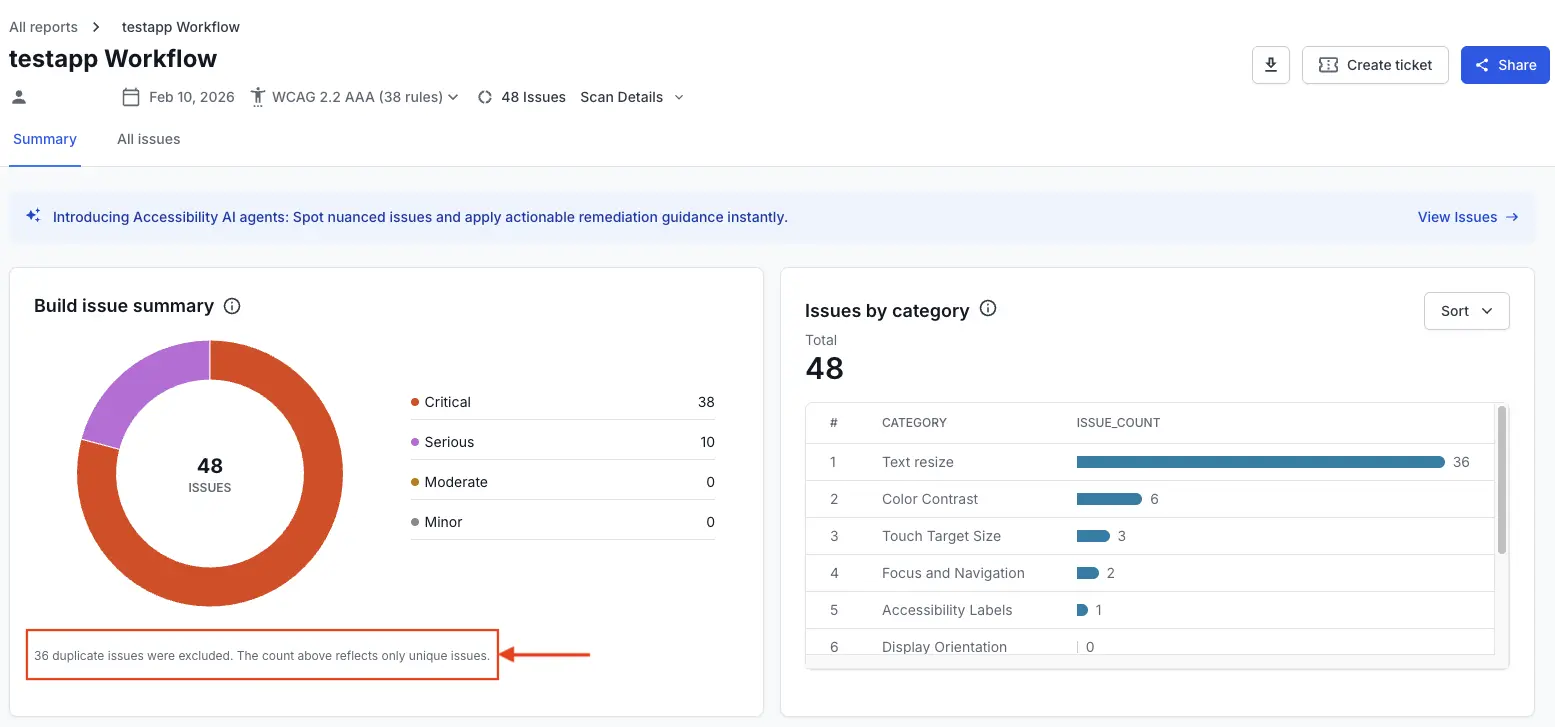
Issue deduplication hides duplicate accessibility violations in the report that is generated when conducting manual or automated tests. This gives you a streamlined view of the accessibility violations you need to fix.
How is deduplication useful
Deduplication enhances your app accessibility testing by:
-
Decluttering dashboards and reports:
Gives teams clearer visibility into real issues by consolidating duplicate issues from dashboards and final reports. -
Reducing inflated issue counts:
Enables teams to focus on actual problem areas without being distracted by repeated instances of the same issue. -
Improving prioritization:
Allows teams to prioritize fixes by highlighting only unique violations.
How does deduplication work
Deduplication hides duplicates from reports in the following scenarios:
- Repeated element on the same screen: The same element appears multiple times on a screen and violates the same accessibility rule. For example, an Add to Cart button with an incorrect accessibility label that appears multiple times on an app screen.
- Same element across multiple screens: The same element appears on different screens or pages in the app and violates the same accessibility rule. For example, a scroll indicator with no focus state that appears on multiple screens or pages in the app.
- Same screen captured multiple times in a scan: The same screen is scanned more than once in a workflow or single test execution. For example, a confirmation screen that appears multiple times in a workflow. Deduplication automatically removes duplicate screens from the report to avoid inflated reported issues.
- Same element across tests in a build: Several tests in an automated build reach the same element, which violates the same accessibility rule in each of them. For example, an unlabeled field on the login screen that a dozen tests reach when they access the app. The build report counts the issue once. For more information, see Deduplication across tests in a build.
By default, duplicate issues are hidden in automated and manual test reports. You can choose to view or hide duplicates in the report as required.
For detailed steps, see:
- Hide or unhide duplicate issues in manual test reports
- Hide or unhide duplicate issues in automated test reports
Deduplication across tests in a build
BrowserStack App Accessibility deduplicates issues in automated test reports at two levels:
- Within a test: Repeated instances of an issue in a single test are counted once. For example, if a Back button with no accessibility label appears on five screens, the test report shows one issue, not five.
- Across tests in a build: When several tests in the same build find the same issue, the build report counts that issue once. For example, if 12 tests each use the app’s bottom navigation bar, an icon with no accessibility label on that bar is reported as one issue on the build report, not 12.
Because of across-test deduplication, the issue count on a build report isn’t the sum of the issue counts of its tests. For example, in a scenario where one test finds 10 issues and another finds 8. If 3 issues appear in both tests, the build report shows 15 issues, not 18. However, each test report still shows every issue that test found.
Issues are deduplicated across tests that run on the same device and OS combination. When the same test runs on more than one device and OS combination, each combination’s issues are counted separately.
Scan deduplication across tests
Scans are deduplicated across tests in the same way as issues. When several tests reach the same app screen, the build report shows one scan for that screen. This scan lists every issue the tests found on that screen.
Deleting a scan at the build level removes it from every test in the build. However, deleting a scan at the test level removes it only from that test.
Reports created before across-test deduplication
Before BrowserStack released across-test deduplication, reports deduplicated issues only within a test. Older reports highlight this legacy behavior with a note. The issue count on an older report may be higher than on one generated after the update, even when both build runs found the same issues. To track your progress accurately, compare two reports generated after across-test deduplication was introduced. For more information, see Compare automated test reports.
Hide and review decisions across tests
The build report shows one entry for an issue that several tests found. Where you hide or review that issue decides which reports the decision applies to.
Hidden issues
Hiding an issue on the build report hides it in every test that found the issue. When you hide the issue inside one or more tests, the build report shows the following states:
| Where the issue is hidden | Issue state on the build report |
|---|---|
| Hidden in some of the tests that found it | Visible |
| Hidden in every test that found it | Hidden |
Needs Review issues
Reviewing an issue on the build report applies your decision to every test that found the issue. When you review the issue inside one or more tests, the build report applies the state with the highest precedence, in the order Confirmed, Needs review, then Hidden:
| Review decisions across tests | Issue state on the build report |
|---|---|
| Confirmed in at least one test | Confirmed |
| Reviewed in every test and confirmed in none | Hidden |
| Not yet reviewed in one or more tests | Needs review |
To reverse a decision, unhide the issue or undo the review in the same place you made the decision. A decision you reverse on the build report applies to every test. A decision you reverse inside a test applies to that test only.
Hide or unhide duplicate issues in manual test reports
Deduplication is automatically applied on manual App Accessibility test reports.
To view or hide duplicates:
- Open the App Accessibility Testing dashboard.
- Go to the Manual test reports page.
- Select the report you want to view. By default, duplicate issues are hidden in the report and the Summary tab will display the following message.
- Click the All issues tab.
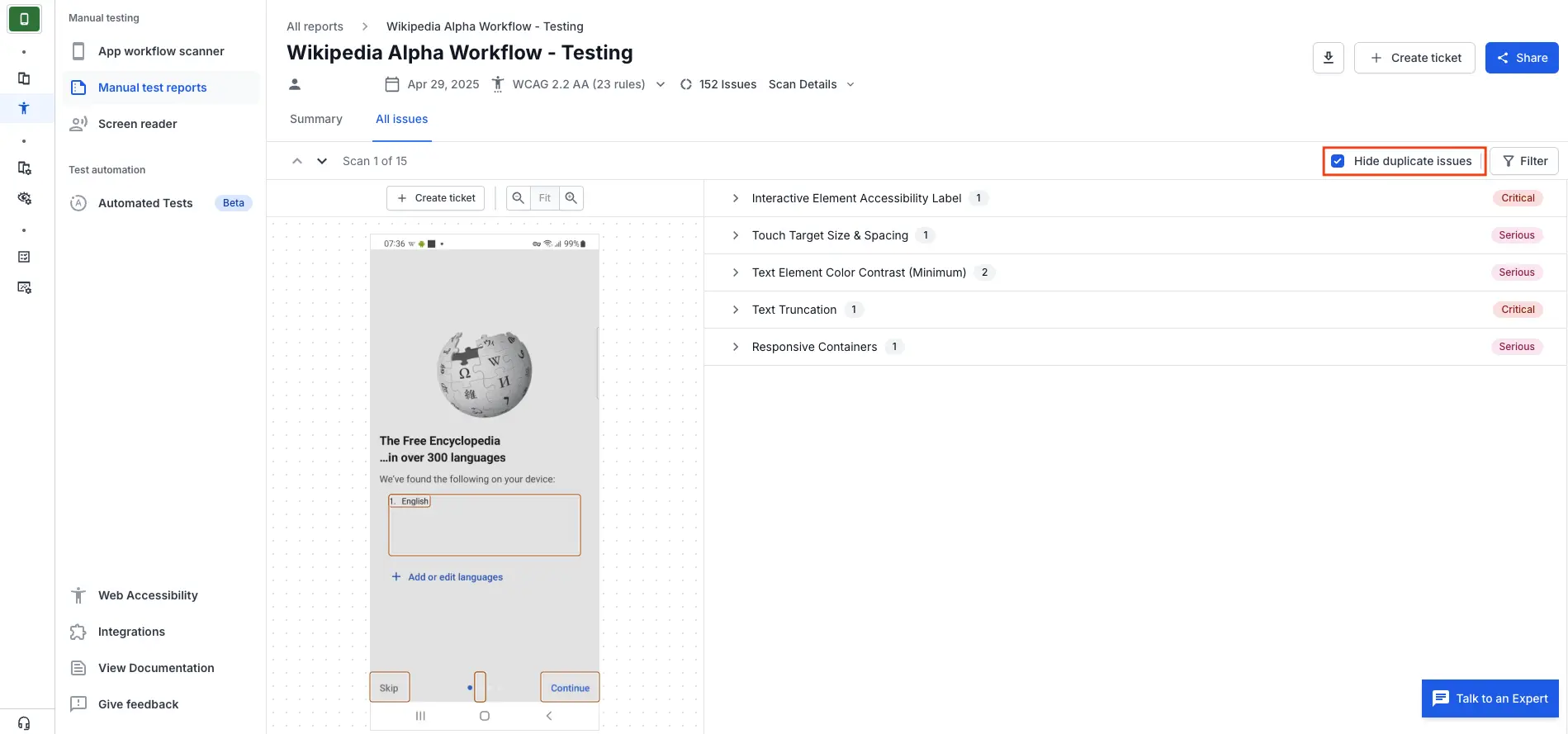
- Toggle the Hide duplicate issues checkbox.
- When unchecked, all violations are shown.
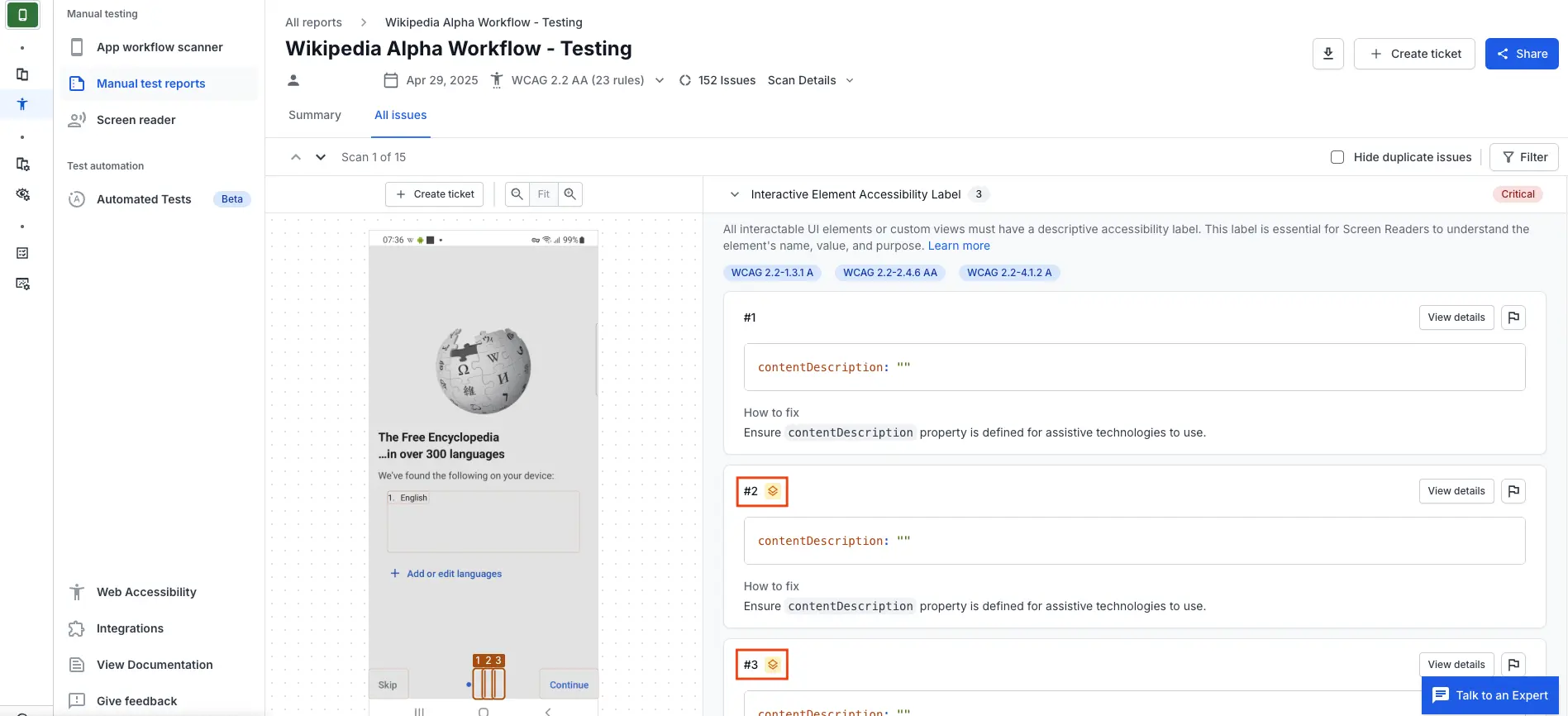
- Duplicate issues are marked with a specific icon indicating that they are duplicates.
Hide or unhide duplicate issues in automated test reports
Deduplication is automatically applied on automated App Accessibility test reports. You do not need to configure your test cases to enable deduplication.
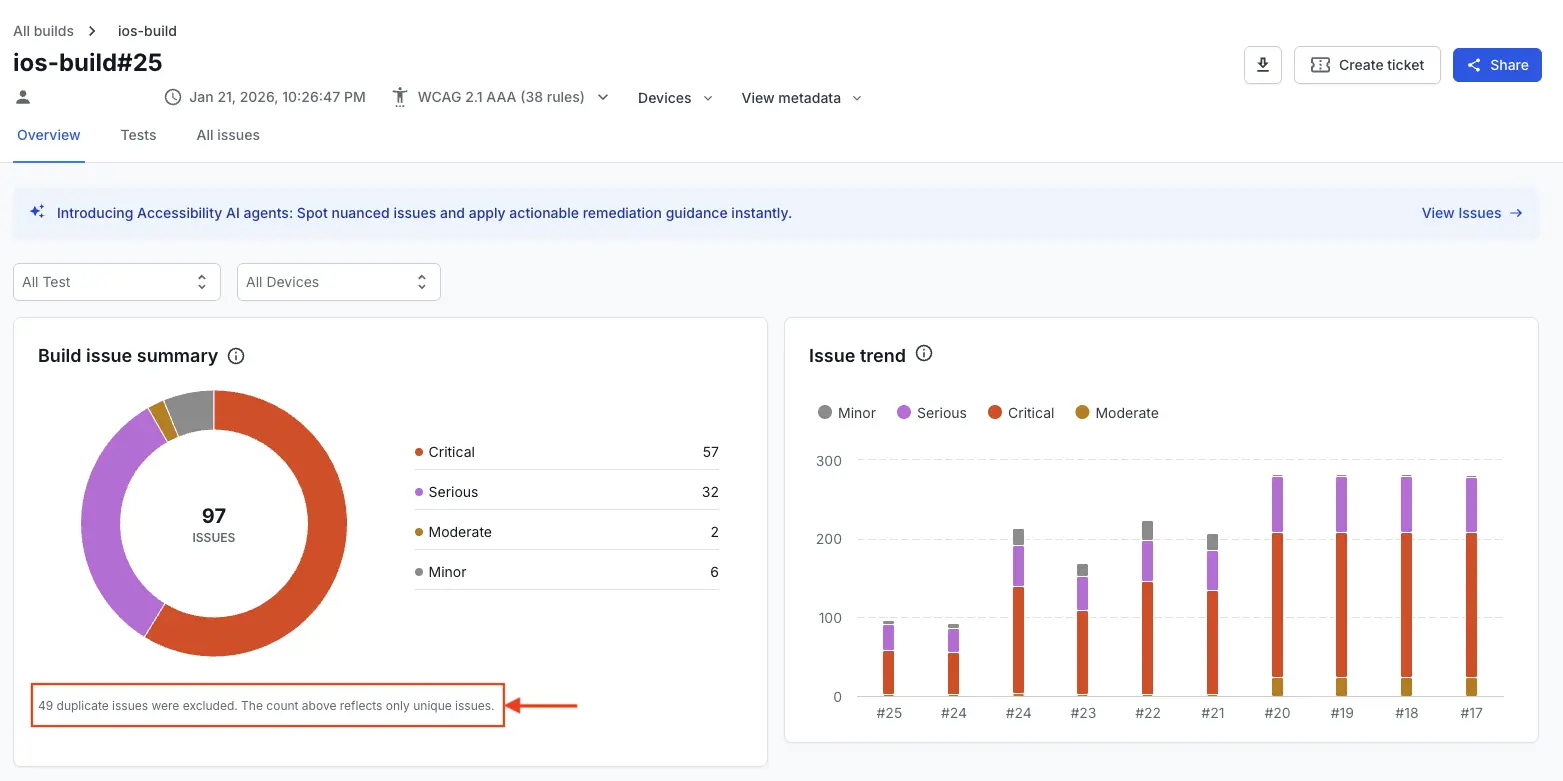
In an automated build, deduplication also applies across the tests in the build. When duplicate issues are hidden, the issue count and the scan count both reflect across-test deduplication. For more information, see Deduplication across tests in a build.
To view or hide duplicates:
- Open the App Accessibility Testing dashboard.
- Go to the Automated Tests page.
- Select the build whose results you want to view. By default, duplicate issues are hidden in the report and the Overview tab will display the following message.
- Click the Tests tab.
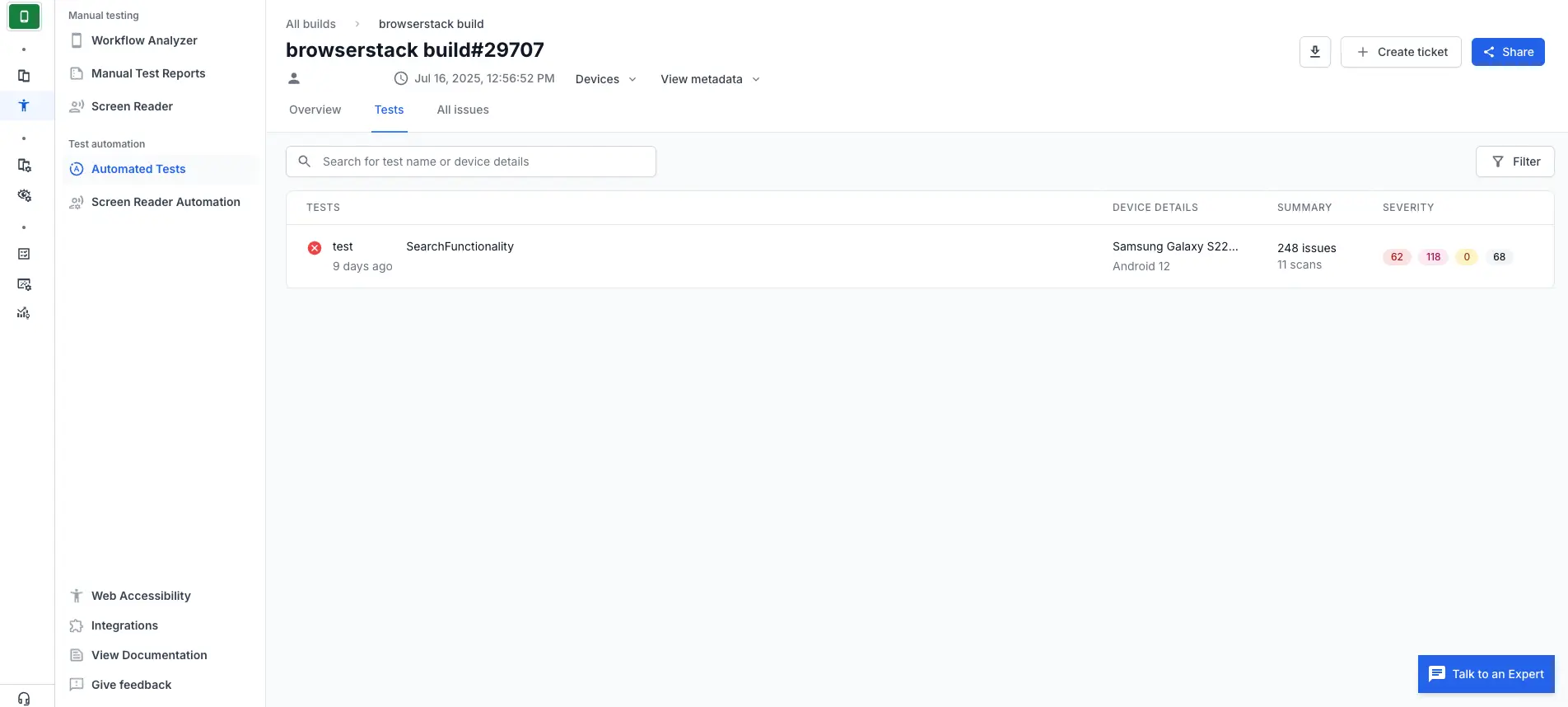
- Select the test case whose results you want to view.
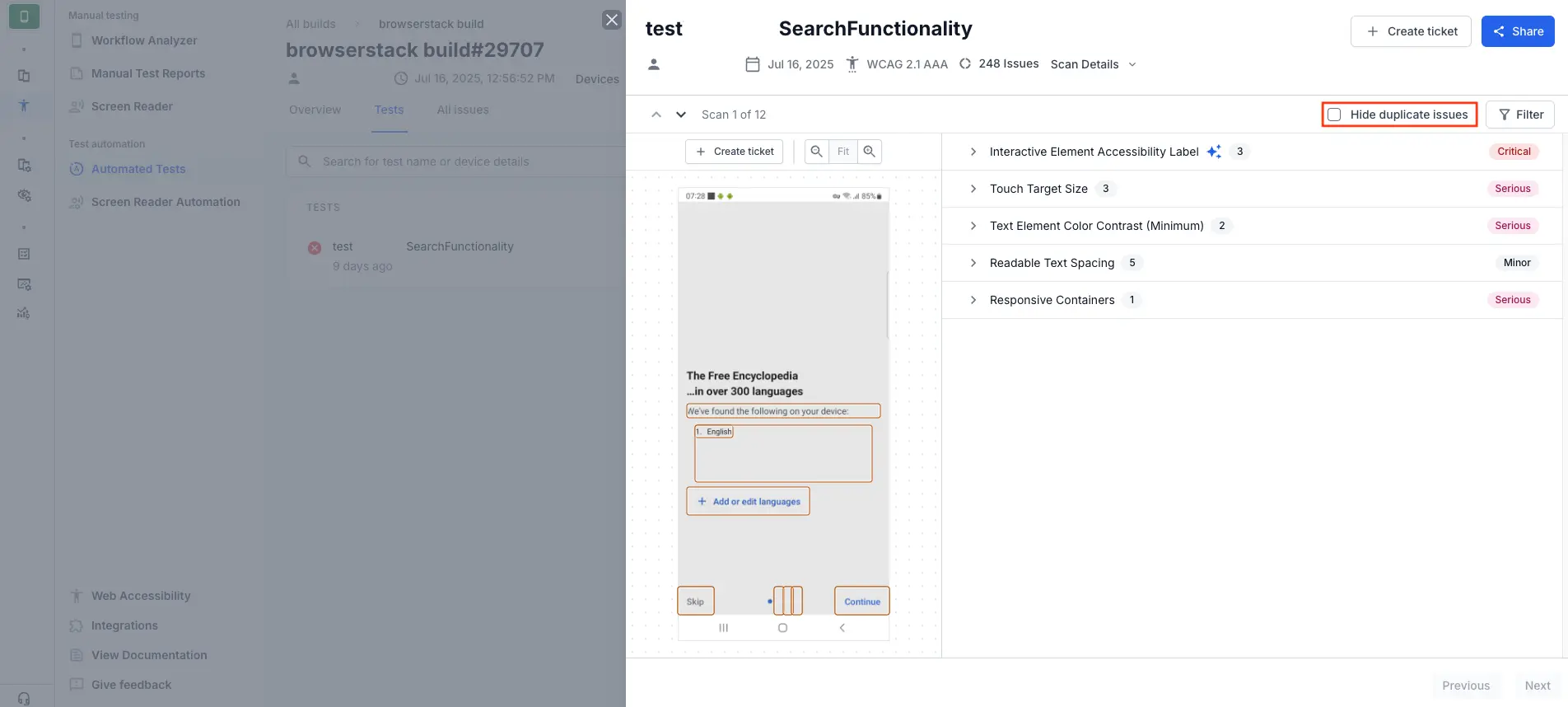
- Toggle the Hide duplicate issues checkbox.
- When unchecked, all violations are shown.
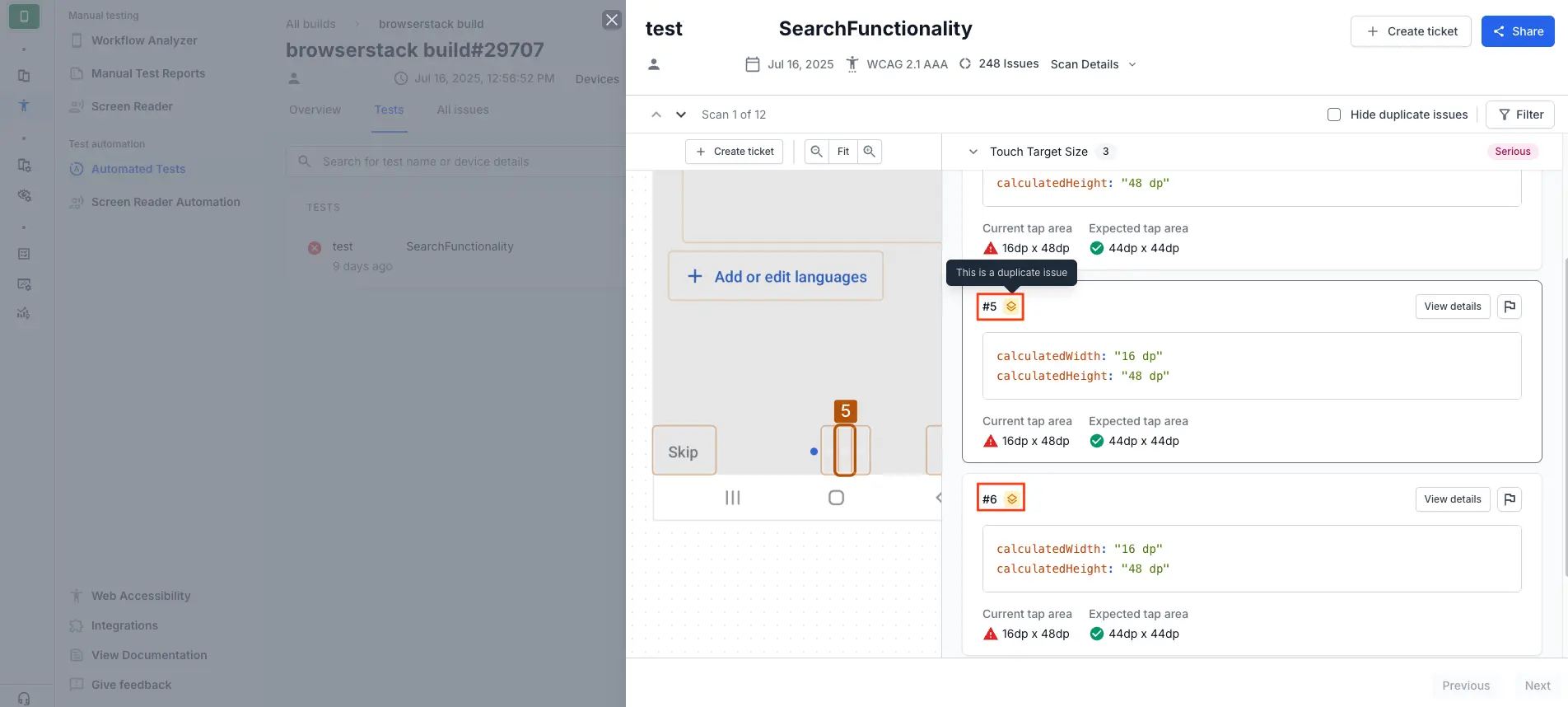
- Duplicate issues are marked with a specific icon indicating that they are duplicates.
We're sorry to hear that. Please share your feedback so we can do better
Contact our Support team for immediate help while we work on improving our docs.
We're continuously improving our docs. We'd love to know what you liked
We're sorry to hear that. Please share your feedback so we can do better
Contact our Support team for immediate help while we work on improving our docs.
We're continuously improving our docs. We'd love to know what you liked
Thank you for your valuable feedback!