
 Join our Discord
Install Test Companion in Visual Studio Code
Install Test Companion in Visual Studio Code, Cursor, or VSCodium to generate, automate, and fix test cases without leaving your editor.
You install Test Companion from the Extensions view, the same way you install any other Visual Studio Code extension. The same flow works in forks such as Cursor, VSCodium, and Kiro.
The setup process has three steps:
Prerequisites
Before you install the extension, make sure you have:
- A BrowserStack account. If you do not have one, create a BrowserStack account.
- Visual Studio Code
1.95.1or later, or an equivalent version of Cursor, VSCodium, or Kiro.
To check your version, choose Code > About Visual Studio Code on macOS, or Help > About on Windows and Linux.
Install the extension
Your editor downloads the extension from the marketplace it already trusts, so you do not have to judge whether a .vsix file from another source is genuine. Use this path by default.
- Open the Extensions view in your editor.
-
Keyboard shortcut:
Ctrl+Shift+Xon Windows and Linux, orCmd+Shift+Xon macOS. - Activity Bar: Click the Extensions icon.
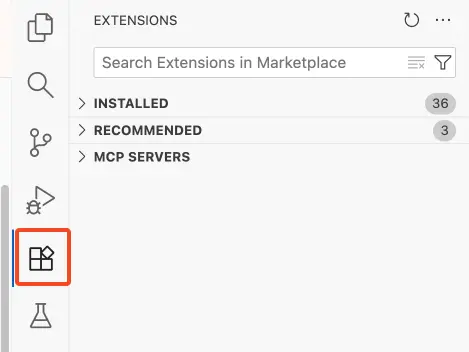
-
Keyboard shortcut:
-
In the search bar, type
Test Companion.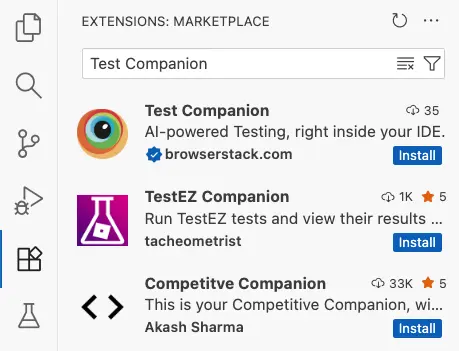
- Locate the Test Companion extension in the results list, published by BrowserStack.
- Click Install.
Verify the installation
After the install completes, look for the Test Companion icon in the Activity Bar, the strip of icons along the edge of the editor window.
Click the icon to open the Test Companion panel.
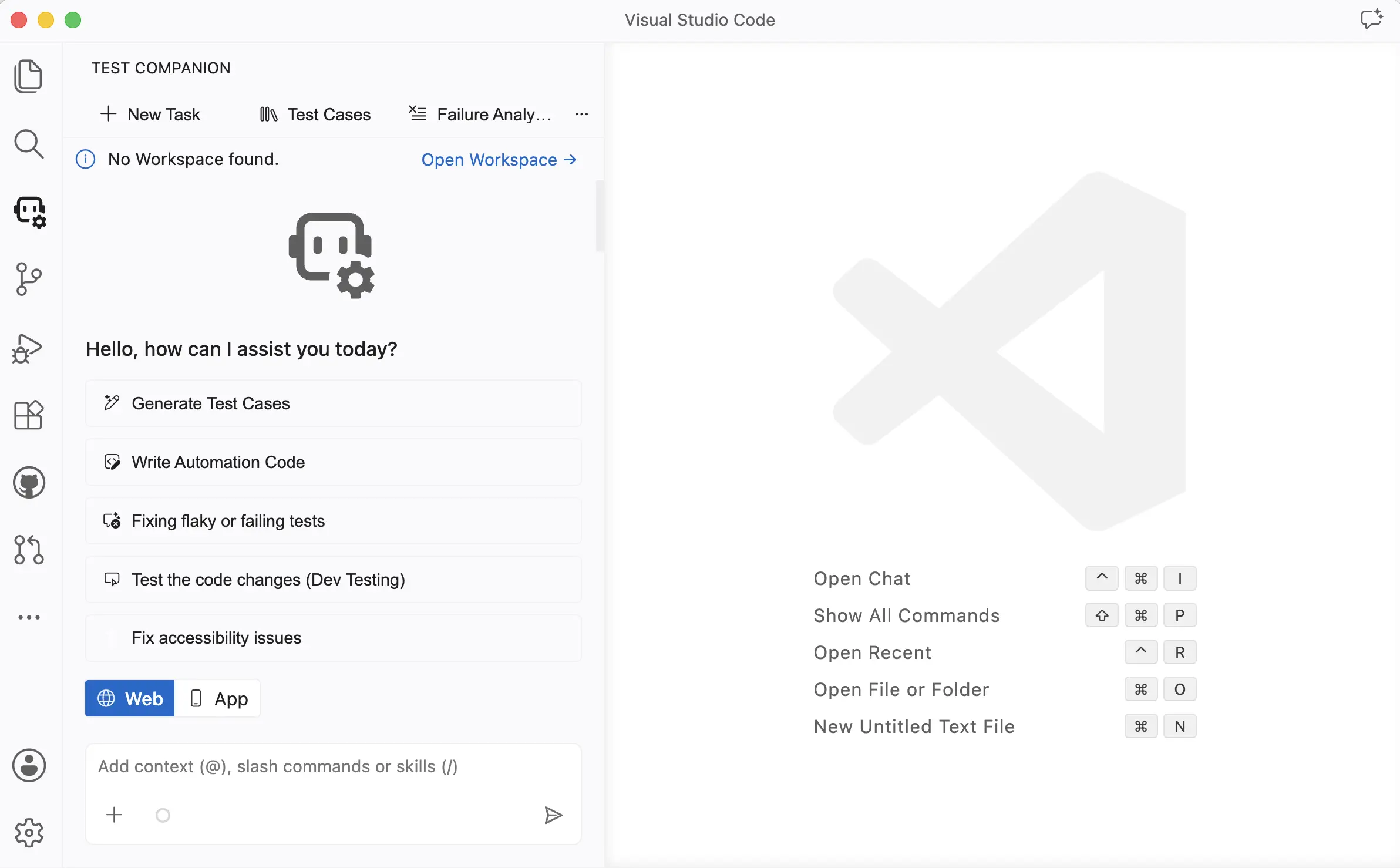
If the icon does not appear, reload the editor window. Open the Command Palette with Ctrl+Shift+P on Windows and Linux, or Cmd+Shift+P on macOS, then run Developer: Reload Window.
To use Test Companion, enable BrowserStack AI in your account settings. For more about these settings, read Activate BrowserStack AI.
Sign in to BrowserStack
Connect the extension to your BrowserStack account.
-
Click the Test Companion icon in the Activity Bar to open the Test Companion panel.
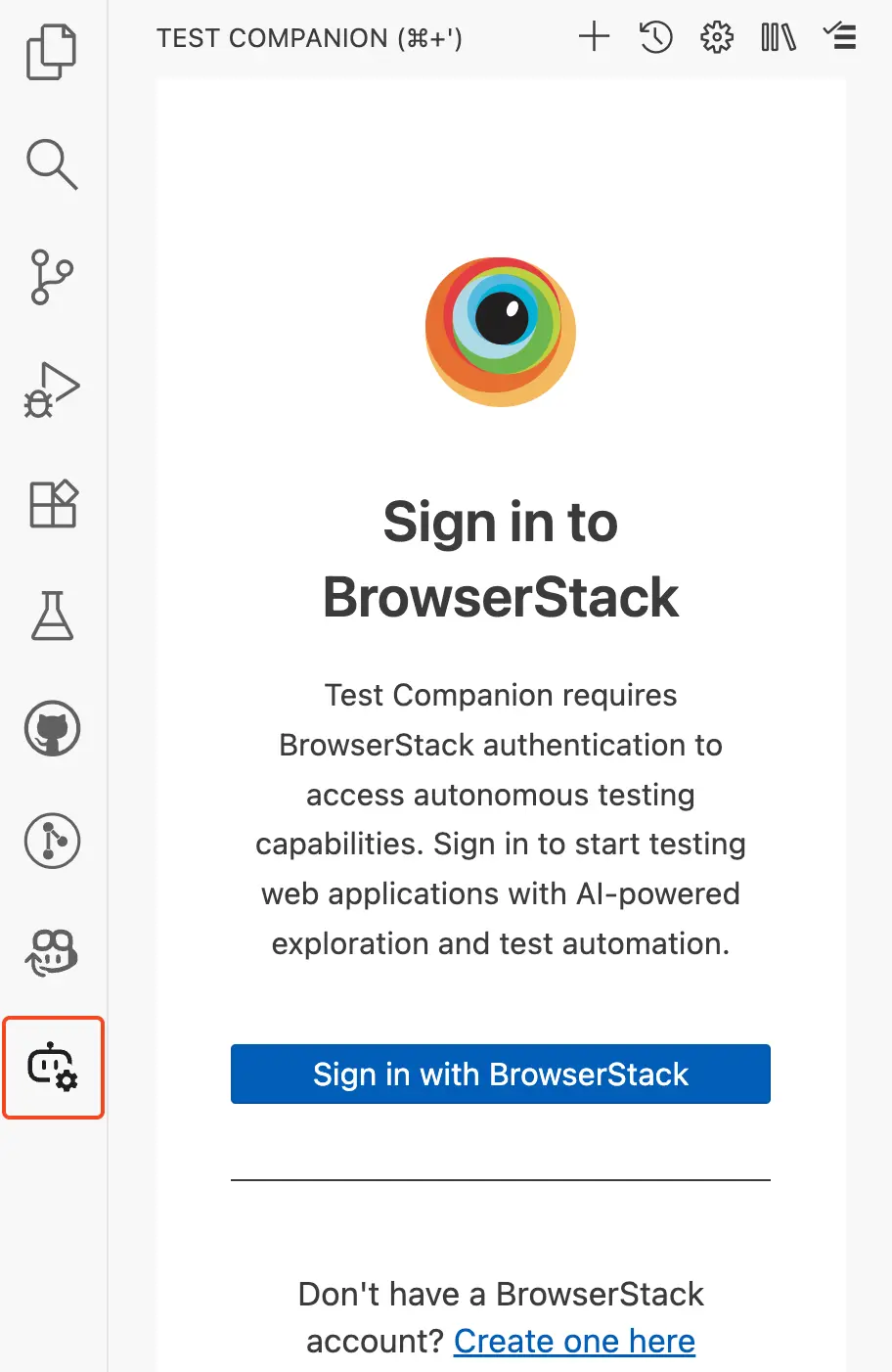
- In the panel, click Sign in with BrowserStack.
- Your default browser opens. It prompts you to authorize the extension.
- Follow the prompts to sign in. If you do not have an account, create a BrowserStack account.
After you sign in, the browser returns you to your editor. The Test Companion panel then shows your user information.
Test Companion is installed and configured.
Next steps
Start exploring what Test Companion can do:
- Generate test cases: Write test cases from requirements using AI.
- Automate tests with AI: Convert manual test cases into executable automation scripts.
- Fix failed tests: Debug and fix test failures using Test Reporting & Analytics.
We're sorry to hear that. Please share your feedback so we can do better
Contact our Support team for immediate help while we work on improving our docs.
We're continuously improving our docs. We'd love to know what you liked
We're sorry to hear that. Please share your feedback so we can do better
Contact our Support team for immediate help while we work on improving our docs.
We're continuously improving our docs. We'd love to know what you liked
Thank you for your valuable feedback!