To celebrate the relentless passion and invaluable contributions of leaders in software quality, BrowserStack is proud to honour some of the icons in the testing space. These are the visionaries who not only push the industry forward with their expertise but also enrich the entire testing community by generously sharing their knowledge and thought leadership.
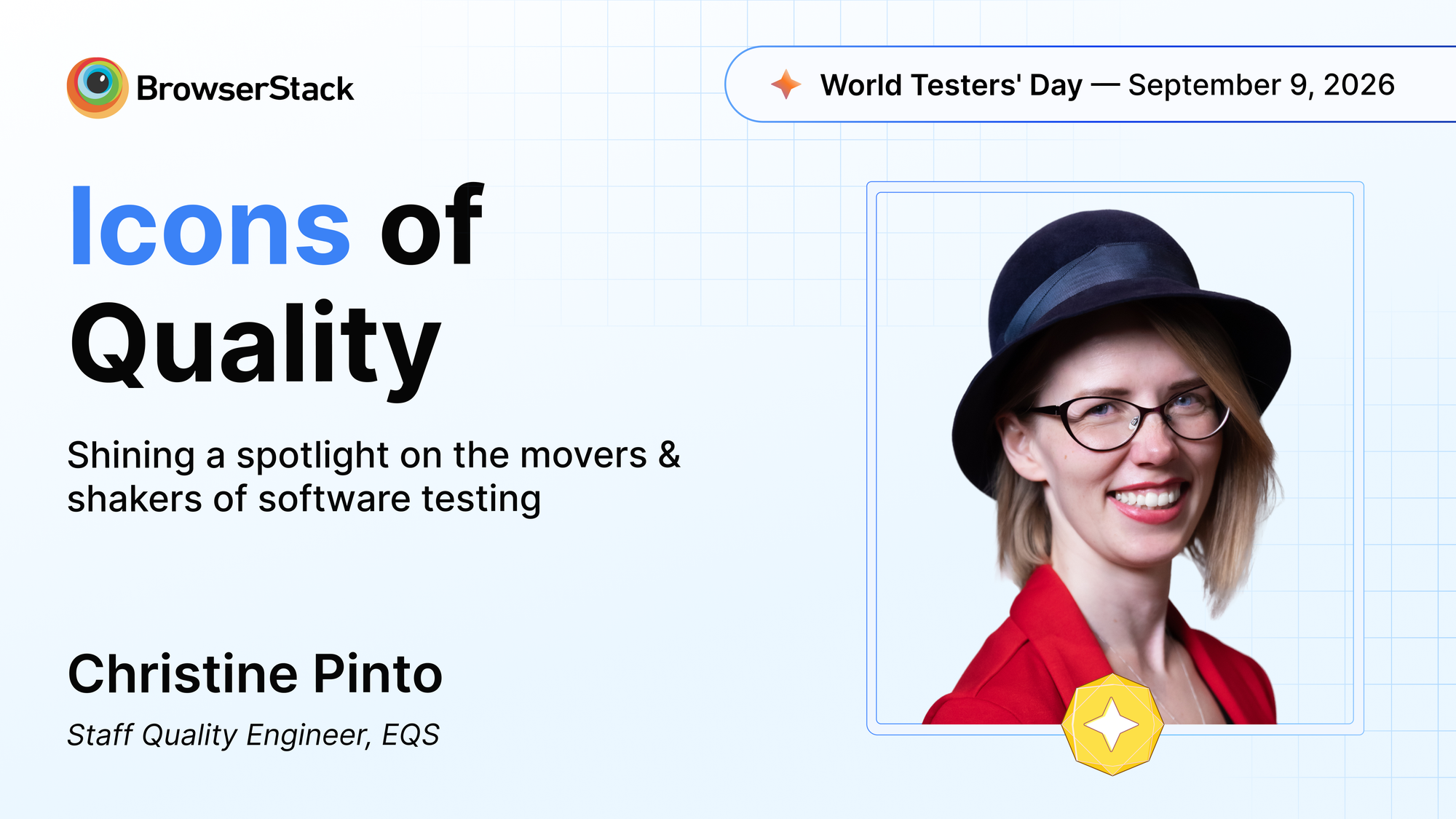
Christine Pinto is an award-winning QA leader with over 18 years of experience, currently serving as a Staff Quality Assurance Engineer at EQS Group based in Berlin. A builder at heart, Christine previously co-founded Epic Test Quest and served as its CTPO, where she developed Wizzo, an AI thinking partner for testers. Beyond her day-to-day engineering work, she is a deeply committed community advocate. She organizes the Ministry of Testing Berlin meetup, sits on the HUSTEF board, and served as a MoT Ambassador in 2025. Whether she is taking the stage as an international speaker or mentoring peers, Christine approaches software quality with the mindset of a dedicated coach rather than a rigid gatekeeper.
We spoke with Christine about the promise of agentic bug triage, the danger of mistaking automation for human judgment, and why being right is only half the job.
I've never had just one job description, no matter where I've worked. I've been the engineer building a form field, the UX person deciding how it should feel, the coach helping the team think about quality, and often the product person scoping what to build next, sometimes all in the same week.
That mix keeps the work interesting. You see a problem from more angles. A UX flaw and a test gap are often the same root issue, just seen from two sides. The tricky part is knowing which hat to wear when. You can't coach and gatekeep in the same conversation. Switching well takes practice, but it's the part of the job I'd miss most if I had to give it up.
The trend that has my attention right now is agentic bug triage. Picture an agent that reads the logs when a bug comes in, checks past tickets for similar issues, and suggests a severity based on real examples, not a guess.
Right now, triage eats a lot of time. A senior tester has to read logs, remember old incidents, and make a judgment call, often under pressure. If an agent can do the first pass well, that time goes back into testing itself, the part only a human can really do. What excites me isn't the automation. It's the consistency. A tired reviewer might rate the same bug as low priority on a Friday and high priority on a Monday. A well-tuned agent won't.
My hot take: AI won't replace testers. But it will expose the testers who were only ever checking boxes.
If your value was running the same script every sprint, AI will do that faster and cheaper than you. If your value was asking "what happens if a user does this weird thing," AI can't do that yet, and won't for a while. So the real risk isn't AI taking your job. It's teams mistaking automation for judgment, and testers who never built judgment in the first place.
If I had to pick one thing, it would be this: think of yourself as a quality coach, not a gatekeeper.
Early on, it's tempting to see your job as the last line of defense, the person who catches what's wrong before it ships. That puts you against the very people you need on your side. It also keeps you reacting to problems instead of shaping how the team thinks about quality in the first place.
The coach mindset flips that. Your job isn't to catch every bug. It's to help the team ask better questions earlier, before code even exists. Sit in on planning. Ask "how would we know if this breaks?" before anyone's written a line. Help developers get better at testing their own work, instead of treating you as the safety net. It's a harder role to grow into than "find the bugs." But it's the one that actually scales. Gatekeepers get overwhelmed as the team grows. Coaches build teams that need fewer gates.
I follow people more than I follow trends. A handful of testers and QA leads whose judgment I trust, and I pay close attention when they post or write something.
Communities matter too. I'm part of Women in Testing and Testing Peers, and I show up there regularly, not just when I need something. That's the real trick, staying in the conversation before you need an answer, not after. If the same topic keeps coming up across a few of these places at once, that's usually my sign to go look closer.
Communication. Testers are often the ones who have to say the uncomfortable thing—that a feature doesn't match what product wanted, that something isn't ready. Being right isn't enough. How you say it decides whether people actually hear you.
I learned this the hard way early on. I told a developer that what he'd built didn't match what product wanted, and honestly, it wasn't working well either. I was right, but I said it badly, more like a verdict than a conversation. He got defensive. Understandably. The information was accurate. The delivery undid it.
Nobody teaches you this in a testing course. You learn the tools, how to write a good bug report. Nobody tells you that half the job is getting people to actually want to hear what you found, especially when it's not what they wanted to hear. If I could go back, I'd tell myself: it's not enough to be right, you have to bring people with you. Lead with curiosity instead of correction. Remember the person in front of you built this thing, and probably cares about it.
Outside of work, I cook, especially Indian food. What I love is how many flavors go into one dish—sweet, sour, spicy, warm spices—and somehow they come together instead of fighting each other.
It's a bit like testing. You're not judging one ingredient. You're tasting how everything works together.
(Responses may have been edited for clarity.)
Christine’s journey reminds us that the most profound impact a tester can make is often cultural, not technical. By shifting from a gatekeeper to a quality coach, and understanding that communication is just as vital as finding a bug, she exemplifies a leader who truly elevates her team. Her ability to synthesize different perspectives—much like balancing flavors in a complex dish—makes her an authentic Icon of Quality.
🎉 Join us in celebrating Christine Pinto and the incredible work of all testers who keep the software world running smoothly.
Stay tuned as we continue to spotlight more #IconsOfQuality in the coming days, honoring those who make a difference in the field of software testing. Check out our past honourees, and if you know someone who’s made an impact in your software testing journey, nominate them here and share your stories using #IconsOfQuality.
Meet the Icons of Quality
