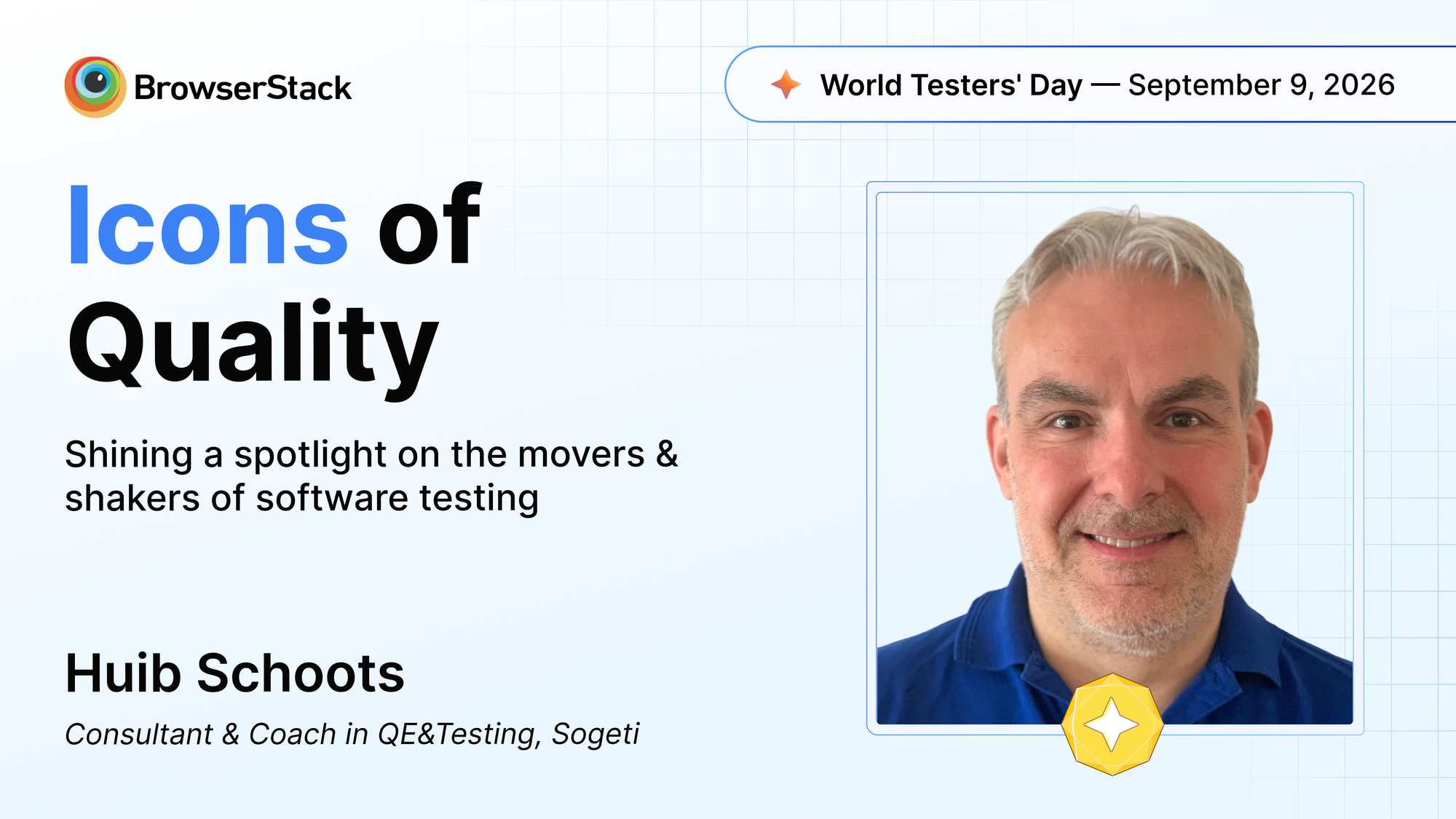
To celebrate the relentless passion and invaluable contributions of leaders in software quality, BrowserStack is proud to honour some of the icons in the testing space. These are the visionaries who not only push the industry forward with their expertise but also enrich the entire testing community by generously sharing their knowledge and thought leadership.
Huib Schoots is a consultant, coach, and Quality Engineering expert based in the Netherlands. Currently serving as a Consultant & Coach in Quality Engineering and Testing at Sogeti, Huib is driven by a personal mission to elevate software quality through connection, innovation, and radical candor. He is notably one of only four Rapid Software Testing Instructors in the world, dedicating a decade to teaching others that testing is a thinking activity, not just a process. A frequent speaker at international conferences like Agile Testing Days, and an active writer on his personal blog, Huib challenges the status quo by encouraging testers to question assumptions, explore risks, and focus on discovering information that helps teams make better decisions.
We spoke with Huib about the fundamental shift required to become a great tester, why AI is useless if you stop thinking, and his simple heuristic for navigating new technology.
Helping people and teams grow, improving software quality, and accelerating organisations in general. More specifically, I love working with people to help them become a better version of themselves. Teaching Rapid Software Testing and speaking at international conferences helps me do exactly that.
I am excited and worried at the same time about AI. AI is a great innovation that can help people do things they couldn't before. It also can accelerate software development if used wisely. My basic heuristic for using AI is: think first, do the work first, then ask AI to help you.
My hot take is that AI will not replace great testers, but it may replace testers who stopped thinking a while ago. The value of a tester was never in executing test cases. It lies in questioning assumptions, exploring risks, making sense of information, and helping teams make better decisions. AI can generate thousands of test ideas, but it still needs human judgment to know which ones matter.
Focus on learning how to think before learning tools. Be curious. Ask questions. Understand the product, the users, and the risks. Testing is not only about finding bugs. It is about discovering information that helps people make better decisions.
The best testers are lifelong learners who constantly challenge their own assumptions. Find mentors. Go to conferences. Read blogs. Watch videos. Explore resources collected by your peers. Look at my website to find my collection of great resources. It is the blog post you'll find there: www.huibschoots.nl.
I learn through a combination of experimenting, teaching, attending conferences, reading books, listening to podcasts, and talking with other testers. Speaking at international conferences and teaching Rapid Software Testing also forces me to continuously challenge and update my own thinking. I believe the best way to learn something is to teach it.
I actively keep an eye on what tool vendors sell and critically think about if that solves real problems. I also talk to many peers about what they do and what innovations they are excited about.
I wish I had known earlier that testing is primarily a thinking activity, not a process. Early in my career, I spent too much time looking for the perfect technique or methodology. Over time, I learned that context matters more than any model or framework. Good testing starts with understanding the situation and adapting your approach accordingly. Rapid Software Testing changed my thinking about testing fundamentally. I wish I did RST in my first year of being a tester.
I am passionate about public speaking, teaching, and helping people develop critical thinking skills. I enjoy creating workshops, giving presentations, and having conversations that challenge assumptions and inspire learning. I enjoy hanging out with friends, brewing (and drinking) beer, playing boardgames, traveling, taking photos, reading and collecting books (which are two very different hobbies), playing the trombone, and singing in a band.
(Responses may have been edited for clarity.)
Huib’s approach to testing reminds us that the most valuable tool in software quality is the human mind. By prioritizing context, curiosity, and critical thinking over rigid processes, he exemplifies a modern quality leader who elevates entire organizations through effective problem-solving and radical candor.
🎉 Join us in celebrating Huib Schoots and the incredible work of all testers who keep the software world running smoothly.
Stay tuned as we continue to spotlight more #IconsOfQuality in the coming days, honoring those who make a difference in the field of software testing. Check out our past honourees, and if you know someone who’s made an impact in your software testing journey, nominate them here and share your stories using #IconsOfQuality.
Meet the Icons of Quality
