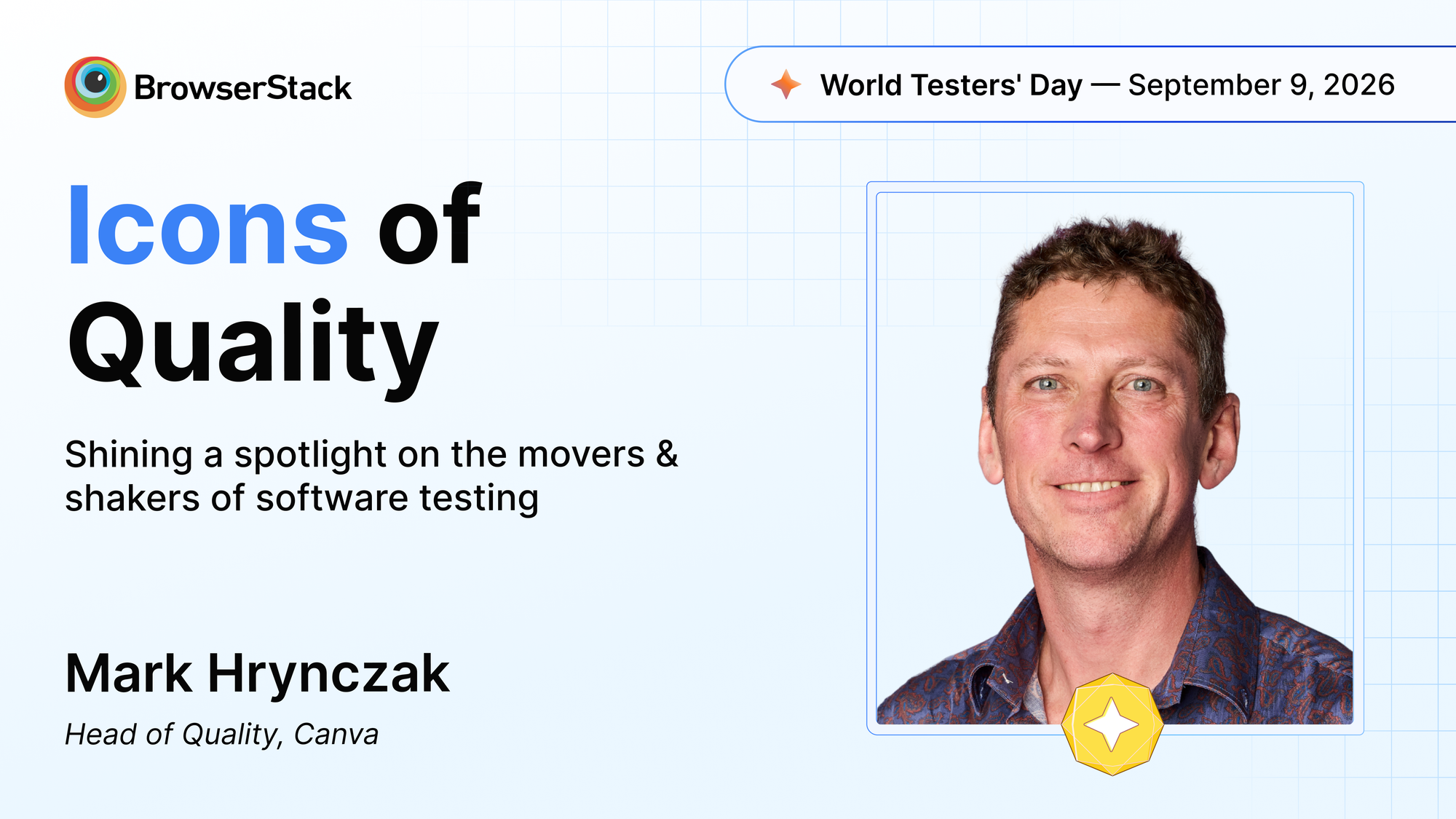
To celebrate the relentless passion and invaluable contributions of leaders in software quality, BrowserStack is proud to honour some of the icons in the testing space. These are the visionaries who not only push the industry forward with their expertise but also enrich the entire testing community by generously sharing their knowledge and thought leadership.
Mark Hrynczak is an engineering leader with over 20 years of experience across QA, SRE, and cloud operations, currently serving as the Head of Quality and QA Director at Canva. During his tenure, Mark successfully evolved Canva's QA function to support engineering growth from 300 to 3,000 global employees, shifting the organization from centralized testing to a distributed, embedded quality ownership model. Prior to Canva, Mark spent nearly 12 years at Atlassian, guiding teams through large-scale AWS migrations and defining product-centric SLOs. A strong advocate for autonomous, high-performing teams, Mark is currently spearheading the integration of agentic workflows and AI-driven decision support to accelerate product velocity without compromising reliability.
We spoke with Mark about the rise of agentic testing, why understanding system design makes you a better tester, and how Canva is leaning into AI-first practices.
Working in a world-class engineering team, and dealing with the scale and speed that comes with it. Canva has over 200 million monthly active users, and we ship changes to production multiple times a day. So QA also has to be world-class, enabling that rate of change, keeping quality high across a large set of complex features with a massive and diverse user base. I believe strongly that the biggest value my QA team provides is empowering our feature teams to move even faster, building and launching features with confidence.
The trend I'm most excited by is the shift to AI-first practices, and specifically agentic testing. A large part of the QA role is toil that can now be delegated to tooling, freeing up human time for deep thinking and complex problem solving. Agentic testing is a significant new capability: we're able to execute testing and verification cycles much faster, and can solve classes of quality problems that just weren't possible before.
There are pitfalls and risks that come with AI, especially AI-generated code, but the potential uplift to productivity makes it worth navigating them. We've invested in building a platform at Canva that enables everyone to extend and implement solutions to unique challenges in their space very quickly, reusing shared skills and teaching the system what we know to uncover what we don't know. It's hard not to be excited by the current rate of change, and leading a QA team through this has been quite an adventure.
The rise of agentic testing, delegating the mechanical execution of tests onto an LLM, has been far more effective than I imagined. I think the successful path for quality-focused engineers to stay relevant is to deeply understand how to build AI into the development cycle, in a way that speeds things up rather than slows them down. I wouldn't say it's replacing humans, but building and using these tools effectively, well beyond just toil reduction and code generation, into guided exploratory testing and fully automated bug reproduction and analysis, is fast becoming the most valuable skillset for a quality-focused engineer to have.
Understand how and why bugs happen, don't focus only on the skill of finding them. It's important to understand the overall system design, how different components interact, and where breakdowns happen because of invalid assumptions or systems getting out of sync. That makes you a better tester: you're more effective at finding problems earlier, and it builds your reputation with other engineers when you aren't bringing them suspected bugs that are really just a misunderstanding of what's happening under the hood.
On top of that, a lot of quality issues emerge because of the human layer: how teams are organised, which areas they own, and where ownership is unclear or undefined. Often those patterns reflect the way the organisation is structured, where internal ownership isn't closely aligned with what users actually care about. So solving quality issues means understanding these patterns and root causes, and being able to effectively advocate for the right changes beyond simply "do more testing".
I have a large LinkedIn network and regularly come across articles, think pieces and hot takes from peers in the industry. Some expose blind spots I didn't know I had, others I strongly disagree with, and engaging with these different perspectives helps sharpen my own thinking. Beyond that, my team has a healthy culture of sharing and promoting new ideas as people come across them, and often the most exciting trends come from inside the team rather than external commentary.
For example, every year Canva hosts AI Discovery Week, a full week where the whole company steps away from day-to-day work to learn, experiment, and build with AI. I'm also engaged with the local testing community and attend conferences, sometimes as a speaker, which is a good way to interact with thought leaders on a more personal basis.
The importance of test automation within the software delivery lifecycle. My first job was 100% manual testing, building test strategies and plans purely around executing manual tests: there was almost an antipathy towards automation in that company at the time.
Having now worked in industry-leading organisations, I've seen firsthand how solid test automation practices aren't optional: they're how we can achieve real engineering excellence. I wish I'd been embedded in a team operating at that level from the start: it would have accelerated my growth, understanding, and appreciation of what that excellence actually looks like.
I really enjoy cooking, creating meals for friends and family who appreciate the creations I make. It's especially satisfying when there are constraints involved: I like the challenge of making something amazing despite limitations: using up leftovers, working around dietary restrictions or healthy eating concerns, while still creating a meal that's delicious and meets my quality standards. It's a great way to finish the working day, to relax by switching my brain to a different mode and working in the kitchen to create excellence.
(Responses may have been edited for clarity.)
Mark’s perspective reveals that modern quality engineering is as much about organizational design and deep system knowledge as it is about verification. By championing agentic AI tools to eliminate toil and focusing heavily on root cause analysis, he embodies a visionary leader pushing the industry toward a faster, more resilient future.
🎉 Join us in celebrating Mark Hrynczak and the incredible work of all testers who keep the software world running smoothly.
Stay tuned as we continue to spotlight more #IconsOfQuality in the coming days, honoring those who make a difference in the field of software testing. Check out our past honourees, and if you know someone who’s made an impact in your software testing journey, nominate them here and share your stories using #IconsOfQuality.
Meet the Icons of Quality
